
Integrated Annual
Report 2024-25

Integrated Annual
Report 2024-25

The global economic landscape demonstrated early signs of stabilisation, with inflation gradually easing from multidecade highs and rate cuts initiated by major central banks. However, renewed tariff actions by the U.S. and countermeasures by trading partners reignited trade tensions, driving policy uncertainty to new highs.
Amid these headwinds, Indian economy remained resilient. The year started with a slow pace of fiscal spend due to elections and tight financial conditions. However, both fiscal impulse and financial conditions improved in the second half of the year. Strong economic activity supported by infrastructure expansion and industrial growth, led to an increase in the electricity demand. In response, we focused on supporting the nation’s twin priorities of transition to renewables and energy security.
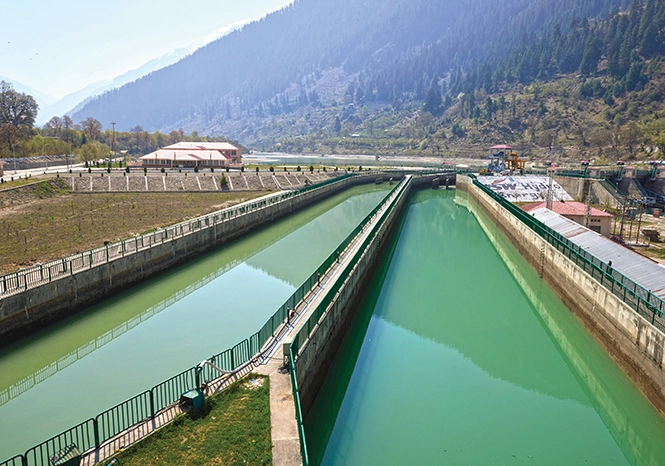
Sedimentation Channel, Kuppa Barrage
The global economy showed tentative signs of stabilisation during the year, following an extended period of disruptions caused by the pandemic, geopolitical conflicts, high inflation, and aggressive monetary tightening. In response to cooling demand and subdued economic expansion, several central banks, including the U.S. Federal Reserve, initiated a rate cut cycle, shifting away from elongated monetary tightening phase.
Despite this pivot in monetary policy, global GDP growth remained modest, constrained by persistent trade frictions, heightened geopolitical tensions, and sluggish manufacturing activity. The global landscape shifted further with the introduction of sweeping U.S. tariff measures, followed by retaliatory actions from key trading partners. These policy moves culminated in near-universal tariffs by April 2025, pushing effective global tariff rates to century-high levels and triggering renewed trade disruptions and market uncertainty.
The International Monetary Fund (IMF) predicts the world economic growth to decelerate in 2025 at 2.8% and in 2026 at 3.0%. Headline inflation is expected to decline to 4.3% in 2025 and 3.6% in 2026.
India continued to demonstrate remarkable resilience amid a turbulent global backdrop. Despite ongoing global trade tensions and policy uncertainty, India remained one of the world’s fastest-growing major economies. GDP growth for FY 2025 is estimated to be at 6.5%, supported by robust domestic demand, sustained momentum in public infrastructure investment, and continued strength in the financial sector. Economic growth remained resilient with projections reflecting a strong trajectory despite global challenges with the Reserve Bank of India (RBI) projecting GDP growth of 6.5% for FY 2026.
The RBI has implemented a cumulative repo rate cut of 100 bps since February 2025 lowering it from 6.5% to 5.5%. The lower repo rate is expected to gradually reduce borrowing costs for businesses and consumers, thereby enhancing credit availability.
India’s structural strengths, along with prudent fiscal and monetary management, continue to anchor its economic resilience and position it as a key growth driver amid a fragile and uncertain global economy.
According to IEA’s World Energy Outlook, October 2024, regional conflicts and escalating geopolitical tensions have highlighted significant fragilities in today’s global energy system, making clear the need for strong policies and greater investments to accelerate and expand the transition to cleaner and more secure technologies. Geopolitical tensions and fragmentation created concerns for both energy security and for global action on reducing greenhouse gas emissions.
Infrastructure remains the bedrock of India’s economic progress, enabling seamless connectivity, enhancing trade efficiency, and delivering affordable and reliable power to support livelihoods and industrial growth. As the world’s fourth-largest economy, India has made transformative strides in infrastructure development over the past decade – laying the foundation for inclusive, climate- resilient, and future-ready urban and rural growth.
India’s ambition to become a developed nation by 2047 is closely tied to sustained investment in infrastructure. The Union Budget of FY 2026 reaffirmed this vision, with a capital outlay of ₹11.2 lakh crore (USD 128.64 billion) for infrastructure development – equivalent to 3.1% of the GDP. This marks a near doubling of the capital expenditure-to-GDP ratio from 1.6% in FY 2019. Further, an additional outlay of ₹ 1.5 lakh crore was proposed as 50-year interest- free loans to states to support capital expenditure and incentivise structural reforms, ensuring that infrastructure-led growth extends to all corners of the country.
Government-led initiatives such as PM Gati Shakti, the National Infrastructure Pipeline, and the logistics policy reforms continue to drive integrated development across sectors. Infrastructure is a critical growth engine in India’s journey towards becoming a USD 10 trillion economy and a developed nation.
India’s power demand continued its upward trajectory in FY 2025, growing by a modest 4.2% year- on-year to 1,694 billion units (BUs). While this growth was on a higher base from previous years, the underlying momentum remains strong with four-year CAGR at 7.4%, underscoring sustained demand driven by robust economic activity, rising residential consumption, electrification of rural areas, and extreme weather patterns such as prolonged heatwaves.
Similarly, peak demand during FY 2025 stood at 250 GW registering a growth of 2.7% YoY while on a four-year CAGR basis it grew by 7.1%. Further, the peak demand is expected to reach 277 GW during FY 2026 and 296 GW in FY 2027.
To support this surge, India continues to expand its generation capacity, enhance grid infrastructure including focus on energy storage solutions, and diversify its energy mix towards cleaner and more reliable sources.
Global commodity markets witnessed significant shifts during FY 2025, shaped by slowing economic growth in China and the Eurozone, persistent geopolitical tensions, and evolving trade dynamics. Steel prices moderated due to weak construction demand in China and rising global supply, while polysilicon prices declined sharply amid a supply glut, impacting solar equipment costs. Oil and gas markets remained volatile, though prices trended lower as global demand softened, U.S. output hit record highs, and Russian exports remained steady. These factors outweighed supply concerns from the Middle East conflict and production cuts by OPEC+. Copper prices also came under pressure due to subdued industrial activity. These commodity trends affected input costs and procurement strategies for energy producers and reinforced the strategic push towards renewable energy and energy security.
FY 2025 marked a historic milestone for India’s clean energy transition, with a record-high addition of 28.7 GW of renewable power generation capacity – the highest ever in a single year. Solar energy continued to lead the momentum, contributing 23.8 GW and total cumulative solar capacity crossed the 100 GW milestone, while wind energy saw a strong resurgence with 4.2 GW added during the year, bringing total cumulative wind capacity to 50 GW as of March 2025. This acceleration reflects the success of key policy initiatives, including annual capacity auctions, supportive regulatory frameworks, and increased private sector participation.
India intensified efforts in FY 2025 to expand its thermal power capacity to address growing base load demand, working towards the long-term target of adding around 80 GW of thermal capacity by FY 2032. Several states conducted competitive bidding for new thermal projects, focusing on advanced supercritical and ultra-supercritical technologies to improve efficiency and reduce emissions. These bidding processes highlight the country’s commitment to enhancing energy security through cost-effective and reliable thermal power, supported by policies ensuring stable coal supply and fuel linkages. This strategic expansion complements India’s broader energy transition, balancing the growing share of renewables with dependable base load power to sustain economic growth and meet rising electricity demand.
India continues to strengthen its regulatory framework for the power sector, fostering a more resilient, efficient, and sustainable energy ecosystem. Reinforcing the AtmaNirbhar Bharat vision, the government strengthened the Approved List of Models and Manufacturers (ALMM), comprising List I for solar PV modules and List II for solar PV cells, to ensure the use of domestically manufactured solar components in projects. Additionally, the Renewable List of Models and Manufacturers (RLMM) was introduced to promote quality assurance and encourage the adoption of indigenously produced wind turbine equipment, further boosting local manufacturing and enhancing supply chain resilience.
To ensure consistent coal supply for thermal power plants, amendments to the SHAKTI scheme introduced more transparent and flexible coal allocation mechanisms, particularly benefiting untied capacities.
Recognising the importance of energy storage for integrating variable renewable energy, the government introduced a dedicated policy framework for Hydro Pumped Storage Projects. This included clear guidelines on project development, land allocation, and tariff structures, encouraging greater private sector involvement. Collectively, these reforms signal a stable, forward-looking regulatory environment, fostering innovation and investment across the energy ecosystem.


