



Corporate Governance
7 out of 11 Board members are Independent Directors which is 63.63% of the total Board strength as against the 50% of target share of independent directors on the board, stipulated by the SEBI LODR Regulations.
We adhere to the minimum attendance criteria as per the Companies Act, 2013. In accordance with Section 167-1 (b) of Companies Act, 2013 – The Directors are required to attend minimum of one meeting conducted during the year. During the reporting year, 9 meetings were conducted for the Board, hence the minimum attendance requirement can be said to be 1 out of 9 which is 11.1%. Average board meeting attendance was 87.77% during FY 2025-26.
Mr. Sunil Goyal is the Lead Independent Director of the company. Mr. Goyal has been appointed as the Lead independent director as on 21 July 2024.
We comply with the maximum permissible limit related to Directorship requirements of the Companies Act, 2013 and Listing Obligation and Regulations Requirement. A person shall not hold office as a director, including any alternate directorship, in more than twenty companies at the same time, out of which maximum 10 can be public. Out of 10 public companies, a director can hold directorship in not more than 7 listed companies. Hence, no Director holds directorships in more than 10 public companies or in more than 7 listed companies. No Director who is serving as Whole time Director / Managing Director in any listed entity is serving as an Independent Director in not more than 3 listed entities.
In alignment with Clause 196 of the Articles of Association, which addresses matters of indemnity and director responsibility, and pursuant to Regulation 25(10) of the SEBI (Listing Obligations and Disclosure Requirements) Regulations, 2015, as amended and Pursuant to Section 149(12) of the Act, JSW Steel has appropriate coverage for its Directors.
As such there are no limitations on directors’ liabilities, however, as part of its governance framework, we maintain a Directors & Officers policy for a defined term, with coverage tailored to the nature and extent of risks as assessed by the Board.
Our Article of Association shows the procedure for election or re-election of directors, in accordance with the provisions of Section 152 of the Companies Act, 2013, each director is subject to election individually based on their tenure of 3 years. One-third of directors retire by rotation and stand for re-election annually.
In accordance with the provisions of Section 14 of the Companies Act, 2013, any alteration to the Articles of Association (commonly referred to as the bylaws) of JSW Energy Limited shall be affected only by passing a special resolution at a general meeting of the shareholders. The proposed amendments must first be approved by the Board of Directors and subsequently placed before the shareholders for their consideration and approval.
We have a robust succession planning framework in place, overseen by the Nomination and Remuneration Committee (NRC), which ensures leadership continuity across the Board of Directors, Key Managerial Personnel (KMPs), and Senior Management Personnel (SMPs).
We have a robust succession planning framework in place, overseen by the Nomination and Remuneration Committee (NRC), which ensures leadership continuity across the Board of Directors, Key Managerial Personnel (KMPs), and Senior Management Personnel (SMPs).
The CEO compensation is a combination of Fixed and Variable Salary; the variable component is ~28% of the total compensation. Out of this variable compensation, 75% payout is linked with company performance and 25% is linked to individual performance criteria. Performance indicators include Nominative generation (75%), Merchant Short term power sales EBITDA (10%), and safety/sustainability related KRA (15%).
JSW Energy is committed to transparency in executive remuneration. The Company discloses the remuneration of directors and key managerial personnel in accordance with applicable statutory requirements.
The Company periodically reviews internal pay structures to ensure competitiveness, fairness, and alignment with performance. Information regarding the ratio between CEO remuneration and median employee remuneration is disclosed in accordance with regulatory requirements, providing stakeholders with a broader understanding of compensation practices across the organization.
As part of the overall remuneration, CEO is entitled to Stock options. Forty percentage of the vesting is time-based, designed to enable talent retention and the balance sixty percent is linked to the Company’s performance (presently achievement of EBITDA targets) as approved by ESOP/Nomination and Remuneration Committee of the Company. The value of options granted varies between 25% – 50% of their total compensation
The CEO’s compensation is structured to reflect the Company’s commitment to performance-driven leadership and long-term value creation.
The annual variation in the CEO’s remuneration is directly linked to a comprehensive performance evaluation process that considers multiple dimensions of executive effectiveness. Key factors include the CEO’s tenure, leadership capabilities, domain expertise, strategic contribution to the Company’s growth, and efforts in human resources development.
Evaluations are conducted using a balanced and transparent framework that adheres to reasonable standards and incorporates both quantitative and qualitative metrics. Financial performance indicators such as sales and operating income, which underpin critical ratios like Return on Equity (ROE) and Return on Invested Capital (ROI), form a core part of the assessment. Comparative benchmarks, including stock price movement relative to energy industry peers, are also considered. In addition, performance is evaluated against the business targets established at the beginning of the financial year, as well as competitiveness and ESG evaluation ratings, to ensure market alignment and stakeholder accountability.
Long-term incentive awards are subject to defined vesting conditions and timelines designed to encourage sustained value creation and reinforce alignment between executive rewards and long-term shareholder interests. Equity-linked incentives, where granted, promote long-term ownership orientation and help balance short-term performance considerations with long-term strategic outcomes.
JSW Energy seeks to align executive compensation with sustainable long-term performance through a combination of fixed pay, performance-linked remuneration, and long-term incentive opportunities, including equity-based awards where applicable.
The CEO compensation is a combination of Fixed & Variable Salary, Variable component as part of the remuneration is ~28% of the total compensation of the CEO. Out of this variable compensation, 75% payout is linked with company performance and 25% is linked to individual performance criteria. Overall EBITDA is used as a toll gate to define payout eligibility. The performance indicators for the variable compensation have weightages as follows; Company performance further linked with achievement against defined performance targets of Normative generation 85%, and safety and sustainability related KRA 15%.
As part of the long-term performance incentive, ESOPs represent a reward system based on performance that helps the Company to attract and retain the top talent while providing an opportunity to CEO to participate in the Company’s growth and create long term wealth alongside the company.
The vesting period is 3 years from the date of grant of options. Vesting will take place in three tranches in a staggered manner with the vesting schedule at 25% at the end of 1 year (first tranche), 25% at the end of 2nd year (second tranche) and the remaining 50% at the end of 3rd year (third tranche) from the date of grant respectively. 40% of the vesting is linked to the CEO staying with the company over the next three years. The balance vesting for 60% of ESOP options is linked to business performance of achieving EBITDA targets for the respective three years with a performance period of 1 year, as part of ESOP scheme (2021).
Code of Conduct
Ethical behaviour in all operations, functions and processes is the cornerstone of any business, guiding their governance of economic, social and environmental responsibilities. A strong and fully embedded commitment to undertaking business ethically brings considerable benefits, including improved consumer perception (leading to increased loyalty), greater investment, reduced costs, and enhanced employee motivation, involvement and interaction to name just a few. As part of our efforts to deliver our Sustainability Vision, we at JSW Energy Limited (‘JSW’) have established Policy on Business Conduct to demonstrate our commitment to embed sound governance, deliver transparency, tackle corruption, manage risks and provide value through strong governance and robust business ethics. In furtherance of this commitment, the Board of Directors has adopted this policy.
We have well-laid down provisions to protect the ethics and promote integrity in the organisation. Our Policy on Business Conduct defines guidelines on ethics, corruption or bribery, statutory and voluntary obligations, insider trading, conflict of interest, transparent disclosures, fair competition, public policy, political activities, charitable, donations, and contributions, financial obligations, protecting consumer value, data protection. To read more. please refer to our Policy on Business Conduct.
We will ensure that we eliminate all forms of bribery and corruption within our business. To do this we will:
JSW does not seek to influence the outcome of public elections, nor to undermine or alter any system of the government. We also aim to ensure that the JSW brand is protected from improper or unethical involvement in any political activities. To do this we will:
We at JSW take pride in our willingness to make charitable donations and contributions for humanitarian needs and other factors, including emergency situations and disaster relief; however, we also recognise that all such donations and contributions must be made responsibly and with due diligence. To do this we will:
Establish internal processes to ensure that all donations or contributions, whether financial or ’in kind’, and irrespective of the amount and jurisdiction, are formally approved.
Whistleblower Mechanism
JSW Energy Limited (the “Company”) believes in the conduct of the affairs of its constituents in a fair and transparent manner by adopting highest standards of professionalism, honesty, integrity and ethical behavior. All our stakeholders are encouraged to freely communicate their concerns about illegal or unethical practices and to report genuine concerns or grievance as also to report to the management concerns about unethical behavior, actual or suspected fraud or violation of the company’s code of conduct or ethics policy. Every report we receive is handled through a structured and transparent investigation process. We begin with a preliminary assessment to determine the validity and seriousness of the concern. Established procedures are in place to address breaches of the company’s policies including JSW Policy of Business Conduct, including corruption, bribery, whistleblower and all other provisions as laid under code of conduct.
Complaints received through the Ethics Helpline are logged and reviewed by the Ethics Chairman, who assesses their nature, severity, potential impact and scope, and assigns them to an Ethics Investigator. Investigations may include document reviews, stakeholder interviews, evidence collection and other fact-finding activities, with findings documented in an investigation report. The report is reviewed by the Ethics Chairman, presented to the Ethics Committee for recommendations on the proposed course of action, and subsequently submitted to the Chief Ethics Counsellor for final approval. Upon approval, the case is formally closed, and the recommended actions are communicated to relevant stakeholders for implementation. We ensure that all outcomes are documented, corrective actions are implemented, and follow-ups are conducted to prevent recurrence.
Any complaints and/or whistleblower incidents received are treated with the highest level of confidentiality, and access to information is restricted to authorised personnel involved in the investigation. We have an Ethics 24×7 Helpline as a confidential platform for reporting any forms of misconduct and whistleblowers. Operated by our third-party provider ‘Integrity Matters,’ the service is accessible in multiple regional languages, including English, Hindi, Tamil, Telugu, Marathi, Kannada, and Bengali, ensuring wider reach and greater inclusivity across our workforce. Reporters can access the helpline through phone, email, web portal, or post box and also submit reports anonymously. Trained professionals process complaints to ensure accurate information collection and protection of the reporters’ confidentiality.
We maintain a zero-tolerance policy for retaliation. We are committed to protecting those who report concerns in good faith, and any retaliatory action is treated as a serious violation of our Code of Conduct. We provide training on the use of the reporting channel to ensure that our employees are aware of and confident in using the whistleblower mechanism.
These initiatives help our teams understand how to access the reporting channel, what types of issues can be reported, and the protections available to them. We ensure that all outcomes are documented, corrective actions are implemented, and follow-ups are conducted to prevent recurrence.
JSW considers any violation related to money laundering, corruption, or bribery a serious breach of its ethical and compliance obligations. Any non-compliance with this Policy will be treated as a serious breach and may result in disciplinary action, including termination of employment, in accordance with applicable laws, JSW’s Code of Conduct, internal policies, procedures, guidelines, and terms of employment.In FY 2025-26, there were zero cases of corruption or bribery, conflicts of interest, and money laundering or insider trading.
The Risk Management framework is guided by the Group level Risk Management team, cutting across all business verticals. Monitoring and auditing of the risk management process is also taken care by the Risk committee, a Board level committee. During meetings with the Board of Directors, the Board is presented with the aspects of Global Energy sector Scenario, Global/Indian Economy, significant geopolitical events impacting energy sector and power industry, risk management practices, including climate-related risks Company’s Financials, Sales, Production, Business Strategy, Subsidiary’s performance before taking on record the financial results of the Company.
The Company employs a balanced risk-management strategy that combines bottom-up inputs with top-down oversight to ensure comprehensive coverage of strategic, operational, technological, reputational, legal, ESG, financial, and emerging risks. The Risk Management Committee (RMC), chaired by an Independent Director, provides independent oversight of long-term strategic and macro risks and focuses on executing strategies and mitigating unintended risks such as performance and process risks.
JSW Energy’s delegation of authority across functions creates effective checks and balances within the system to close possible gaps in decision-making and control. This combined bottom-up / top-down construct ensures local risk visibility (at plants and functions) and inputs from central functions along with inputs from Senior Leadership and the RMC, so that mitigations are implemented promptly.
An in-depth understanding of our risk process is provided in our Integrated report FY 2025-26.
Our company’s Internal Audit function encompasses best global standards and practices of international majors into its operations. The Internal Audit Department reports to the Audit Committee comprising Independent Directors who are experts in their respective fields. These Independent directors are also part of Risk Management Committee. Internal Audit department prepares annual audit plan after considering risks reported in RMC.
Internal Audit also reviews Risk Management measures reported in risks. The Internal Audit function has enterprise-wide access to information, enabled by ERP across the organisation, ensuring timely, complete, and reliable evidence for audits.
The Company has implemented an Internal Audit software to record, track, and close audit observations, providing end-to-end visibility and accountability. At the start of each year, Internal Audit prepares an Annual Audit Plan after considering business and process risks; the frequency of audits is decided by risk ratings of areas/functions.
The audit plan is reviewed periodically to include areas that have assumed significant importance in line with emerging industry trends and the aggressive growth of the Company. In addition to in-house reviews, the Company engages external expert firms (including reputed accounting firms) to audit critical areas, strengthening independence and assurance.
The Board, through the Risk Management Committee comprising Independent and Non-Executive Directors, provides dedicated oversight of the Company’s enterprise risk management framework and regularly reviews key strategic, operational, financial, compliance, sustainability, and emerging risks.
The Risk Management Committee reports its findings and recommendations to the Board at regular intervals, enabling effective Board oversight of the Company’s risk profile, mitigation measures, and risk appetite.
Our approach to enterprise-wide risk management encompasses both bottom-up and top-down strategies. The bottom-up process involves the identification and regular assessment of risks by our respective plants and corporate functions, followed by the implementation of effective mitigation strategies. Concurrently, our Risk Management Group (Senior Leadership Team) and the Risk Management Committee (RMC) adopt a top-down approach to identify and evaluate the long-term, strategic and macro risks to our business.
The Risk Management Committee (RMC), chaired by an Independent Director, provides independent oversight of long-term strategic and macro risks. We adhere to the globally recognized Committee of Sponsoring Organisations (COSO) framework for Enterprise Risk Management (ERM).
Our Risk Appetite Framework is structured in a manner to align with our long-term strategic objectives, financial resilience, and regulatory responsibilities. A measured risk appetite informs our approach to strategic and financial exposures, enabling a prudent balance between sustainable growth and operational stability. Also, risks are identified based on scanning of external environment to ensure that it is aligned with our Risk appetite framework.
The identified risks are evaluated by the senior management depending on the impact and the likelihood and the final list of risks are prioritised for the organisation.
Risk Severity is determined after considering two factors: Impact on Business & Probability of Occurrence. Basis this, a Risk Severity matrix is constructed, and the risk appetite of the company is determined accordingly.
| Risk Type | Risk Name | Risk Rating | Movement | Impact | Mitigation Strategies |
|---|---|---|---|---|---|
| Financial Risk | Foreign Exchange Risk | Low | Unchanged | Currency fluctuations impacting import costs and foreign currency debt servicing |
|
| Financial Risk | Interest Rate Risk | Low | Unchanged | Rising interest rates impacting borrowing costs and project IRRs |
|
| Project Risk | Project Execution Risk | Medium | Unchanged | Delays in project execution impacting timelines, costs and returns |
|
Our company’s risk exposure is reviewed twice a year at the meeting of the Risk Management Committee of the Board.
The Company maintains a comprehensive enterprise risk management framework that is integrated with its internal control systems. The effectiveness of these controls, including those governing risk identification, assessment, mitigation and monitoring, is independently reviewed as part of the statutory audit of Internal Financial Controls over Financial Reporting (IFCoFR). The results of the review are periodically presented to the Audit Committee and the Board, ensuring ongoing oversight and continuous improvement of the Company’s risk management practices.
Regular risk management education:
Our Enterprise Risk Management (ERM) framework, implemented in 2010, ensures that all designated risk owners at both plant and corporate levels receive awareness training through e-learning modules on the Risk Management framework, enabling them to identify new risks effectively. The Board is kept informed about the risk management process and sector-specific risks, while Independent Directors and Non-Executive Directors are familiarised with their roles, rights, responsibilities, the nature of the industry, business model, and related risks as part of the Board Familiarisation Program as well. A comprehensive e-learning module on “Risk Management” is available to all JSW Energy’s Directors (All Directors), employees, inclusive of senior management through JSW Learning Academy.
This training ensures a thorough understanding and effective implementation of risk management across the organisation. Incorporation of Risk Criteria in development of products and services
As a thermal power generating business the major risk for JSWEL is generation of GHG emissions as the future of the power sector demands power generation with a mix of renewable energy.
To address this risk, JSW Energy is presently engineering an energy mix makeover by investing in renewable energy assets to become a net zero company latest by 2050. Tangible goals at the organizational level are set for reducing GHG emissions, solid waste generation, water management & achieving no net loss in biodiversity. We aim to implement a cleaner fuel mix and reduce specific fuel consumption for our existing thermal plants by vastly scaling our portfolio of greenfield renewable assets, across wind and solar.
We also evaluate emerging technologies across green hydrogen; off-shore wind; storage solutions including battery and pumped hydro storage. Having surpassed our target of 10 GW installed generation capacity by FY 2025, we unveiled Strategy 3.0 charting the course for FY 2030, with a stated goal to achieve 30 GW power generation and 40 GWh energy storage capacity by FY 2030. Financial incentives which incorporate risk management metrics At JSWEL safety is identified as a part of KRA for Senior executives with a mandatory weightage of 15-25%. The variable performance pay (incentives) is linked to this KRA.
The following safety criteria are part of the KRAs for Senior executives:
JSW Energy’s ERM framework promotes a risk-aware culture through regular risk education for Directors and employees, integration of risk considerations into strategic and business decisions, and alignment of management performance objectives with key risk indicators. These practices ensure that risk management principles are embedded across governance, day-to-day operations, long-term business planning, and performance management processes.
| Name of Emerging Risk | Category | Description | Impact | Mitigating Actions |
|---|---|---|---|---|
| AI (Artificial Intelligence)-driven electricity demand outpacing grid readiness | Technological | The rapid adoption of AI and expansion of hyperscale data centres are creating large, concentrated and increasingly dynamic electricity loads. These demand patterns may develop faster than conventional generation and grid planning cycles, resulting in a mismatch between electricity demand and available generation, transmission and distribution capacity. The uncertainty associated with AI-driven load growth may require energy companies to reassess traditional demand forecasting, capacity planning and infrastructure development approaches. | Rapid and concentrated AI-driven electricity demand may result in grid congestion, capacity constraints and challenges in maintaining reliable power supply. This may necessitate reprioritisation or acceleration of investments across generation and storage infrastructure. Conversely, uncertainty regarding the timing, location and scale of such demand may lead to sub-optimal capacity allocation or underutilisation of assets, potentially affecting asset utilisation, capital efficiency and returns on investment. | Our diversified portfolio across thermal, hydro, solar, wind and hybrid assets provides flexibility to respond to evolving electricity demand. The growing pumped hydro and battery storage portfolio further supports system flexibility. Long-term PPAs provide visibility over contracted demand and cash flows, while centralised monitoring, platform-level analytics and in-house O&M capabilities support plant availability and operating efficiency across its diversified asset base. |
| Skilled Human Capital and Specialist Talent Gaps | Operational / Strategic | Business expansion in Thermal and New Energy segments, along with backward integration through manufacturing activities, is occurring in a highly competitive and dynamic talent landscape. This includes Renewable Business initiatives such as Wind, Solar, Pump Storage Projects, and Battery Energy Storage, as well as Solar Module, Battery, and Wind Blade Manufacturing. Additionally, scaling renewable energy, storage, and emerging hydrogen businesses requires niche expertise in digital, operational technologies (OT), and new energy domains. While we have expanded leadership and capability development programs, rapid business growth increases the risk of talent retention challenges and skill mix gaps. |
|
An aligned hiring strategy is being implemented through RPO (Recruitment Process Outsourcing) engagement for volume hiring, walk-in drives across states for select functions, and empanelment of segmented recruitment consultants for Renewable, Hydro, Thermal, and PSP businesses. Employee referrals will be encouraged by introducing an attractive policy, while cadre building will be strengthened through the intake of fresh Diploma, Engineering, and Management trainees. Market mapping initiatives are also underway to ensure proactive talent availability. Additionally, skill development programs are being designed in partnership with external agencies, customized to business needs, such as through the Philips Institute. Further, high-potential talent from mergers and acquisitions will be evaluated for expanded or critical roles. |
Stakeholder Engagement and Materiality Assessment
Our Stakeholder Engagement Framework guides the identification and prioritisation of stakeholders who are directly and indirectly affected by our operations. The process includes identifying stakeholder representatives and engaging with local communities, self-help groups, district-level government authorities, NGOs and Panchayati Raj Institutions (PRIs), including affected communities that may experience environmental or social impacts associated with our operations. As part of this process, we also identify vulnerable groups, including marginalised and disadvantaged communities, indigenous peoples and local tribes. Our stakeholder engagement strategy enables us to develop targeted initiatives to strengthen relationships with different stakeholder groups, including local communities. The framework is applied across all local operations and extends to relevant parts of our supply chain. We maintain a robust grievance mechanism that provides clear communication channels for stakeholders to raise concerns. Local stakeholders may register grievances through designated community relations teams at corporate or plant locations, while CSR offices at each site provide an additional channel where required. A defined escalation process helps track and address grievances, and all concerns received are recorded in a grievance register.
As part of our Stakeholder Engagement programme, we conduct Social Impact Assessments for all new projects. In certain situations, capacity-building programmes are established to enable affected stakeholders, particularly local communities and organisations, to participate fully and effectively in the process. Open communication helps us review local stakeholders’ perceptions of our engagement strategy and make changes, where necessary. We also conduct periodic meetings with surrounding communities to understand their needs and concerns, providing a platform for transparent and collaborative two-way dialogue. Our procedure is applied across all local operations and as part of our supply chain. We have a robust governance mechanism that provides a clear communication channel between community representatives and the Company. Local stakeholders can send an email to our community relations team at the corporate level or at any of our plant locations to register their grievances. A defined escalation process enables us to track and address grievances.
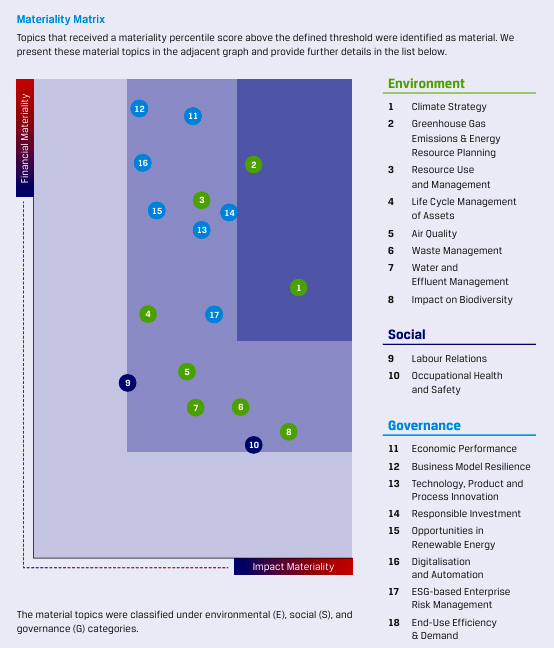
JSW Energy undertook a comprehensive double materiality assessment, covering both impact and financial dimensions. The impact assessment followed an inside-out approach in line with the Global Reporting Initiative (GRI) 2021 Universal Standards, while the financial materiality analysis adopted an outside-in perspective, guided by the IFRS Foundation and SASB frameworks.
The assessment was anchored on two key pillars: stakeholder engagement and impact analysis. Through a structured stakeholder engagement process, inputs were obtained from internal and external stakeholders to understand evolving ESG priorities. The assessment considered the scale, scope and likelihood of actual and potential impacts across both materiality dimensions.
The Company undertakes an annual review of its material topics as part of the Business Responsibility and Sustainability Report (BRSR) review process, enabling the Board to reassess the continued relevance of material matters in light of evolving stakeholder expectations and business priorities. The annual review considers changes in the Company’s operations, business environment, stakeholder expectations and sustainability-related risks and opportunities. If significant changes are identified, the materiality matrix is updated accordingly. A comprehensive double materiality assessment is undertaken periodically, with the latest comprehensive assessment conducted in FY 2024.
The disclosure of the Company’s material topics is covered within the independent third-party assurance of its sustainability reporting.
The outcomes of the materiality assessment are integrated into the Company’s Enterprise Risk Management process. Material topics are mapped to relevant business and ESG risks, supporting the consideration of sustainability-related matters in the Company’s key decision-making processes. Our Materiality Assessment results are presented to and reviewed by the Board of Directors, with final approval and sign-off provided by the Board to ensure alignment with the Company’s strategic priorities and governance framework.
Sustainability objectives across all operations and regions are embedded in the annual Key Responsibility Areas (KRAs) of top management and cascaded down to line management performance indicators. Approximately 15-20% of KRAs for key senior management roles are directly tied to safety and sustainability parameters.
For senior leadership, including the Executive Committee, KRAs focus on advancing the ESG agenda. Key priorities include expanding the renewable energy portfolio to drive decarbonization, reducing fresh-water consumption, 100% fly-ash utilization, committed to achieving no net-loss status for biodiversity, lowering air emissions, strengthening community engagement, and promoting good governance through collaborative initiatives and stakeholder engagement.
Prioritization of Material Topics
Identified topics are assessed based on the scale, scope and likelihood of their actual or potential impacts and ranked according to their strategic importance. Quantitative scores are derived for each ESG topic across the impact and financial materiality dimensions. Topics receiving a materiality percentile score above the defined threshold are identified as material and presented in the materiality matrix.
| Particulars | Material Issue 1: Climate Strategy | Material Issue 2: Water and Effluent Management | Material Issue 3: Air Quality |
|---|---|---|---|
| Business Case | As a significant player in India’s energy landscape, we ensure reliable, affordable and sustainable power while supporting national green transition pathways and Net Zero ambitions. Expanding and diversifying into a low-carbon, clean-energy portfolio de-risks the enterprise and secures long-term competitive returns. | Water is a finite, vital resource for fundamental plant processes like cooling, fire safety and ash handling. Optimising efficiency, lowering specific freshwater intake and minimising wastewater discharge are essential to insulate production schedules from worsening regional water stress. | Thermal power generation results in emissions of particulate matter, sulphur oxides and nitrogen oxides. Effective air-emission management is essential for maintaining regulatory compliance, avoiding environmental liabilities and ensuring the operational continuity and competitiveness of thermal assets. |
| Business Strategies | Renewable-led growth: Rapidly expanding installed wind, solar and hydro capacities to achieve 30 GW of operational generation by FY 2030, ensuring over 70% of the locked-in portfolio is powered by renewables.
Energy optimisation and digitalisation: Enhancing operational eco-efficiency and lowering auxiliary power consumption (APC) using the JSW PI System and Integrated Digital Command Centre (IDCC) for real-time asset monitoring. Internal carbon pricing: Applying an internal carbon price of USD 11–12/tCO₂e to evaluate the economic viability of upcoming low-carbon projects. Climate-risk assessment: Assessing physical and transition risks through scenario analysis and incorporating the results into strategic planning and mitigation measures. |
Recycling infrastructure: Operating industrial Reverse Osmosis (RO) to reduce dependency on raw water sources.
Water-neutrality framework: Scaling Scope 1 water neutrality and water positivity assessments under NITI Aayog guidelines across assets to minimise watershed footprints. Zero Liquid Discharge: Treating, recycling and reusing process wastewater within plant premises. Water conservation: Implementing rainwater harvesting, cooling-tower blowdown reuse, treated sewage reuse, improved water storage and process optimisation across operational sites. |
Emission-control technologies: Deploying and upgrading electrostatic precipitators, flue-gas desulphurisation systems and low-NOx burners across thermal operations.
High-efficiency ESPs, low-NOx burners and FGD units have been installed at the Ratnagiri Power Plant. ESP modifications have been completed across all eight units at the Barmer Power Plant. At the Vijayanagar Plant, Toranagallu, the units comply with applicable particulate matter and NOx requirements, while boiler modification to enable the use of waste gas as fuel is under progress to further reduce SO₂ emissions. Low-NOx burners have been installed at JSW Energy (Utkal) Limited, where ESP upgradation with hybrid bag filters is proposed for FY 2026–27. At JSW Mahanadi Power Company Limited, low-NOx burners and Over-Fire Air systems have been installed across all operating units to control NOx emissions. Digital monitoring: Using continuous emission monitoring systems and digital tools for real-time monitoring and timely corrective action. Operational optimisation: Improving combustion efficiency, auxiliary power consumption and equipment performance to progressively reduce emission intensity. Regulatory compliance: Operating power plants within the applicable emission limits and environmental requirements. |
| Business Impact | Risk: Physical climate risks, including rising temperatures, increasing water stress, intense rainfall, floods and cyclones, may affect operational continuity and asset performance. Transition risks arising from regulatory changes, carbon pricing, higher levies on fossil fuels and changing customer preferences may influence operating costs and profitability. | Risk: Power generation is water-intensive, particularly for thermal power plants. Water scarcity, variability in availability and quality, and increasing water costs may affect plant operations, production continuity and operating costs. Insufficient wastewater management may also create environmental, regulatory and compliance risks. | Risk: Air emissions from thermal operations may result in regulatory, operational, environmental and reputational risks. Non-compliance with prescribed emission limits could lead to environmental liabilities, additional capital expenditure, operating restrictions and reduced competitiveness of thermal assets. |
| Target | Achieve 30 GW of installed generation capacity by FY 2030, with more than 70% renewable-energy capacity in the portfolio.
Reduce GHG emissions intensity by approximately 50% from the FY 2020 baseline by FY 2030. Achieve carbon neutrality by 2050. |
Reduce water consumption per unit of energy produced by approximately 38% from the FY 2020 baseline by FY 2030.
Achieve specific freshwater intake of 0.68 m³/MWh by FY 2030. Maintain Zero Liquid Discharge across all power plants. |
By FY 2030:
Reduce particulate-matter emission intensity to 0.064 kg/MWh. Reduce SOx emission intensity to 0.75 kg/MWh. Reduce NOx emission intensity to 0.46 kg/MWh. |
| Progress | Achieved 13,454 MW of installed generation capacity in FY 2026, comprising 7,796 MW of renewable capacity and 5,658 MW of thermal capacity.
Renewable energy constituted approximately 58% of the operational portfolio. Achieved GHG emissions intensity of 0.59 tCO₂e/MWh, representing approximately a 25% reduction from the FY 2020 baseline. Approximately 75.97% of FY 2026 capital expenditure was directed towards renewable-energy projects. Internal carbon pricing of USD 11–12/tCO₂e was applied for project evaluation. We have avoided 5.7 million tCO₂e through renewable-energy generation. |
FY 2026 specific freshwater intake was 1.257 m³/MWh, compared with 0.99 m³/MWh in FY 2025. The increase was due to the addition of 350 × 2 MW and 600 × 3 MW thermal power plants that operated for the full year.
Recycled and reused 65,76,418 kL of wastewater during FY 2026. ~10-15% Wastewater recycled every year. Reused 20,42,264 m³ of treated process and domestic water for horticulture across operational sites. Maintained Zero Liquid Discharge across power plants. |
FY 2026 particulate-matter emission intensity was 0.083 kg/MWh.
FY 2026 SOx emission intensity was 1.80 kg/MWh. FY 2026 NOx emission intensity was 0.84 kg/MWh. Air-emission performance during the year was affected by the addition of 350 × 2 MW and 600 × 3 MW thermal power plants operating for the full year. Continued the use of ESPs, FGD systems, low-NOx burners, digital monitoring and operational optimisation to manage emissions. |
| Particulars | Impact 1: Climate Strategy | Impact 2: Water |
|---|---|---|
| Material Issue for External Stakeholders | Climate Strategy We have identified GHG emissions contributing to climate change as the most significant impact on external stakeholders. |
Water We have identified scarcity of water resources as the most significant impact on external stakeholders. |
| Cause of Impact | JSW Energy’s thermal power-generation operations use coal and generate greenhouse gas emissions. The Company is also exposed to physical risks such as rising temperatures, increasing water stress, floods and cyclones, and transition risks associated with regulatory changes, carbon pricing and higher levies on fossil fuels. | The impact arises primarily from the withdrawal and consumption of water for power-generation processes, including cooling, ash handling, steam generation and fire protection, as well as from the generation of process wastewater and domestic effluent. Water use and effluent-related impacts are associated with the Company’s operations, electricity-generation services and relevant activities within its supply chain. |
| Impact Areas Evaluated | Environment, Society, Consumers and other value chain partners. | Environment, Society, Consumers and other value chain partners. |
| Topic Relevance | The continued operation of thermal power plants and the use of coal generate greenhouse gas emissions that contribute to climate change and may affect the environment and society. The Company is also exposed to physical and transition climate risks. JSW Energy addresses these impacts by expanding its renewable-energy portfolio, improving operational energy efficiency, assessing climate-related risks and incorporating internal carbon pricing into investment decisions. The Company has set a target to achieve 30 GW of installed capacity by 2030, with more than 70% renewable energy in its portfolio. These measures support the transition towards reliable, affordable and lower-carbon power. | Water-use efficiency is crucial for JSW Energy’s operations and stakeholders. The Company relies heavily on water for cooling, steam generation and other critical processes. Efficient management ensures operational continuity, reduces water-scarcity risks, minimises regulatory challenges and mitigates environmental impact. It also safeguards local communities by preventing over-extraction and ensuring water availability for agriculture and domestic needs in stressed regions. Regulators increasingly demand sustainable practices, and efficiency helps maintain compliance and the social licence to operate. For investors and financial institutions, it signals strong resource stewardship, reducing risks, enhancing reputation and improving access to capital. Conversely, water shortages can disrupt operations, causing delays and higher costs. |
Information Security Management
For us, cybersecurity is a top priority. As we embed digitalisation into our operations, our business is more prone to cyber threats. We have meticulously devised ways through which we can protect our business and our stakeholders, through various vulnerability and breach assessments, keeping ourselves updated as per the industry best practices. This is headed by our Chief Information Officer and overseen by the Risk Management Committee of the Board. Mr. Sharad Mahendra brings in diverse experience of 33 years spanning organizational strategy, business growth, execution, sales and marketing, and people development across the steel, power, chemicals, and automobile sectors. He has been associated with the JSW Group for 15 years. His responsibilities include providing strategic oversight to key organizational functions and committees, including the Information Technology function in the company.
At JSW Energy, we recognize the critical importance of safeguarding our digital infrastructure and ensuring business continuity in the face of potential cyber threats. Our information security-related business continuity plans are designed to maintain operational resilience, minimize downtime, and protect sensitive data during disruptions. These plans are regularly reviewed and tested to ensure effectiveness.
We also conduct internal audits of our IT infrastructure and information security management systems to identify vulnerabilities, assess whether ISMS conforms to JSW’s own requirements for its Information Security, the requirements of the standards and to evaluate effectiveness of the IT general controls. Corrective actions shall be taken in case of any non-conformity to the requirements. The effectiveness of the corrective action taken shall be reviewed and changes shall be made to the information security management system, if required. The audit is carried out as per the Internal Audit Plan approved by the Audit Head.
To further strengthen our security posture, we have established a clear escalation process that enables employees to report incidents, vulnerabilities, or suspicious activities promptly. This process ensures that all reports are addressed swiftly by the relevant teams, with appropriate follow-up and resolution to prevent recurrence and mitigate risks.
Furthermore, we actively manage system vulnerabilities through comprehensive Vulnerability Assessment and Penetration Testing (VAPT) of all public-facing assets and enforces firewall hardening rule sets. Additionally, we carried out a series of cybersecurity posture enhancements designed to strengthen resilience across our enterprise environment. These collective efforts underscore the company’s robust and proactive approach to cybersecurity.
Regular training and awareness programmes help employees understand how to access reporting channels, the types of concerns that may be reported and the protections available to them. These efforts have helped us to ensure zero cybersecurity breaches and zero breaches of customer privacy data were reported during FY 2025-26.
At JSW Energy Limited, we are progressively strengthening our responsible artificial intelligence (AI) practices to support innovation while protecting people, data, operations and stakeholder trust. AI and machine-learning solutions are used across selected business and operational contexts, including decision support, analytics, productivity, predictive maintenance and process optimisation. Our governance approach is risk-based, with accountability, assessment, validation, human oversight and monitoring requirements increasing according to the potential impact, autonomy, data sensitivity and operational criticality of each use case.
Our approach is aligned with JSW Energy’s Information Security Management System (ISMS) and requires the use of approved AI services, role-based access and cybersecurity controls proportionate to risk. AI use cases involving personal data, confidential business information, third-party platforms or material system integrations are subject to applicable privacy, information-security, legal, architecture and supplier-risk requirements. JSW information is not permitted to be used to train shared third-party models unless specifically authorised following the required reviews.
Access to sensitive AI capabilities, including biometric identification, facial recognition, surveillance technologies, emotion-recognition systems and other higher-risk AI applications, shall be restricted to specifically approved business purposes and authorised personnel. Such use cases shall be subject to enhanced governance, risk assessment, legal and privacy review, and additional security controls proportionate to the associated risks. Unauthorised deployment or use of sensitive AI capabilities is prohibited.
AI is intended to support, rather than replace, accountable human judgement. High-risk or irreversible decisions require meaningful human oversight, including the practical ability to question, override, escalate or stop the system. AI-generated outputs must be appropriately verified before being relied upon for legal, regulatory, financial, engineering, safety, employment, security or external-communication purposes. Material AI involvement, intended purpose, capabilities and limitations are to be communicated where required by law, contract, risk or reasonable stakeholder expectation.
Where appropriate and practicable, AI-generated content, recommendations, analyses, communications or AI-assisted decisions shall be clearly identified as AI-generated or AI-assisted to support transparency and informed decision-making. Material AI involvement in customer-facing, employee-facing or stakeholder-facing outputs shall be disclosed in accordance with applicable legal, regulatory, contractual and business requirements.
We have implemented processes to monitor the performance of AI models deployed in areas such as predictive maintenance and operational optimization, enabling early detection of model drift and periodic recalibration.
We maintain formal grievance and escalation mechanisms, allowing stakeholders to raise concerns related to algorithmic decisions. These mechanisms provide an accessible, fair, and responsive platform for users, enabling them to seek redress or clarification through clearly defined pathways.
Where AI systems may materially affect individuals or stakeholders, relevant risks of bias, discriminatory outcomes and accessibility are to be assessed and addressed using data, populations and operating contexts appropriate to the use case. JSW Energy also considers the environmental implications of AI and promotes energy-efficient infrastructure, appropriately sized models, optimised computing and responsible technology and supplier selection, in alignment with its broader sustainability objectives.
Our employees undergo continuous training on digital technologies, including the secure and ethical use of AI systems.
Monitoring and revalidation requirements are being strengthened across the AI lifecycle. Depending on the nature and risk of the use case, these may include monitoring of model performance, drift, data quality, harmful outputs, security events, user feedback, overrides, availability and operational impact. AI systems used for predictive maintenance, operational optimisation or other material applications are expected to operate within defined performance thresholds and approved operational boundaries, with accountable owners and appropriate escalation, recalibration, suspension or rollback mechanisms.
Responsible AI topics are being incorporated into periodic, role-based digital and information-security awareness programmes. AI-related concerns, including material errors, unfair outcomes, privacy, security, safety or misuse, are to be routed through the relevant information-security, privacy, ethics, grievance, safety or service-management channels so that they can be appropriately investigated, escalated and addressed.
Where relevant and feasible, JSW Energy also considers, the environmental implications of AI and promotes energy-efficient infrastructure, appropriately sized models, optimised computing and responsible technology and supplier selection, in alignment with its broader sustainability objectives. This may include the measurement of impacts such as energy-efficiency improvements, resource optimisation, emissions reduction, waste minimisation, equipment reliability, operational efficiency and other environmental or social performance indicators. Insights from such assessments may be used to support continuous improvement and informed decision-making.
AI governance controls and management practices are periodically reviewed to assess their effectiveness, alignment with applicable legal and regulatory requirements, and consistency with emerging responsible AI standards and best practices and are aligned to ISO/IEC 42001. Such reviews may include internal assessments, independent evaluations and management reviews, as appropriate. Findings and recommendations from these reviews are used to strengthen AI governance, risk management, operational controls and continuous improvement across the AI lifecycle.


