


The energy sector is not insulated from climate change impacts and particularly vulnerable to risks due to its dependency on fossil fuels, energy-intensive production processes, and large carbon footprints. However, the sector becomes a solution to climate change mitigation and provides with an opportunity for transition to production of non-fossil based energy, i,e, energy from renewable sources, nuclear energy, hydrogen based energy, etc. As the world is transitioning towards net-zero, energy companies have a critical role to play in this transition by giving the world access to sufficient amount of renewable energy or non-fossil energy.
With renewables becoming a significant part of JSW Energy’s power generation mix of the future, we are on the forefront to cater to growing demand for the cleaner fuel mix leading towards a better tomorrow. Apart from Solar, Wind & Hydro, we are assessing emerging technologies across green hydrogen and its derivatives, offshore wind, and storage solutions, including battery, and pumped hydro storage. We have set our targets to reduce our emissions and contribute in mitigating climate change. We made a commitment to endorse and uphold the recommendations of the Task Force on Climate-related Financial Disclosures (TCFD). By aligning with these recommendations in its four pillars, we aim to enhance our understanding of the potential impact of climate change and make well-informed decisions regarding current and future decarbonisation strategies.
Climate-related Incentives and Performance Management integrates climate change and broader Environmental, Social and Governance (ESG) considerations into its performance management and remuneration framework, reinforcing accountability for the delivery of the Company’s sustainability objectives across leadership and relevant business functions. ESG-related targets are incorporated into the performance assessments of senior leadership, including Executive Directors, Senior-mid Managers and Business Unit Managers.
ESG parameters constitute a mandatory Key Result Area (KRA) for senior leadership and account for approximately 15-20% of the annual performance assessment linked to variable remuneration. Key performance areas include safety, environmental stewardship, climate change, community impact, product responsibility, and governance.
JSWEL provides incentives for the management of climate change issues, including the attainment of targets.
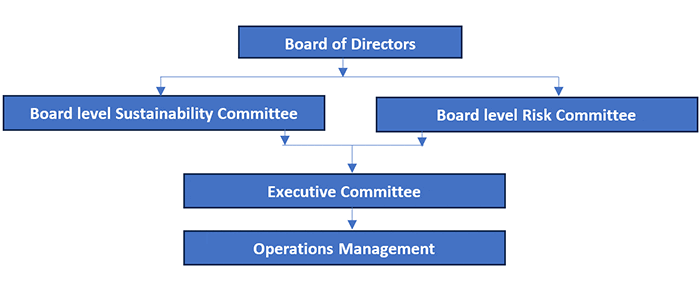
JSW Energy’s board of directors demonstrates strong leadership in overseeing climate-related matters, ensuring that they are fully integrated into the company’s overall business strategy. At the Board level, the Sustainability Committee and the Risk Management Committee review climate-related matters during biannual meetings and report to the Board of Directors. At the management level, the Executive Committee and corporate function teams oversee climate-related matters. We have a dedicated climate change policy with focus on preventing causes, mitigating impacts, and building resilience to climate change.
JSW Energy’s board of directors demonstrates strong leadership in overseeing climate-related matters, ensuring that they are fully integrated into the company’s overall business strategy. At the Board level, the Sustainability Committee and the Risk Management Committee review climate-related matters during biannual meetings and report to the Board of Directors. At the management level, the Executive Committee and corporate function teams oversee climate-related matters. We have a dedicated climate change policy with focus on preventing causes, mitigating impacts, and building resilience to climate change.
Our sustainability efforts prioritise non-fossil-based energy and sustainable development, along with transparency in operations and investments. Recognising the significance of climate risks in our business strategy and decision-making, we adopted the recommendations of the Task Force on Climate-related Financial Disclosures (TCFD) to strengthen climate governance, improve transparency and enhance resilience across operations.
In alignment with TCFD recommendations, we assess current and emerging regulatory, legal, technology, market, reputational, acute physical and chronic physical risks across our own operations, upstream supply chain and downstream markets.
This climate change risk assessment helped us to identify the risks related to our operations, upstream activities and customers.
Climate scenario analysis is used to assess the resilience of the Company’s operations and strategy under different physical and transition pathways, identify assets with higher exposure, evaluate potential operational and financial implications and develop appropriate mitigation and adaptation measures. The analysis combines qualitative risk assessment with quantitative, location-specific modelling and considers short-, medium- and long-term horizons.
Scenario analysis as per RCP 4.5 and RCP 8.5 plays an important role in assessing climate-related risks and opportunities. Where, RCP 4.5 represents a pathway where greenhouse gas emissions are moderately stabilized by the end of the 21st century through significant mitigation efforts. On the other hand, RCP 8.5 depicts a high-emission pathway without adequate climate policies, resulting in substantial increase in greenhouse gas concentration.
During the reporting year, we completed a detailed climate hazard and adaptation assessment for the Ratnagiri Thermal Power Plant using SSP2-4.5, SSP3-7.0 and SSP5-8.5. SSP2-4.5 represents a middle-of-the-road pathway with moderate challenges to climate mitigation and adaptation. SSP3-7.0 represents regional rivalry and high challenges to mitigation and adaptation. SSP5-8.5 is used for worst-case stress testing under a high-emissions pathway.
The assessment evaluates floods, cyclonic winds, storm surges, sea-level rise, heatwaves, earthquakes and related operational impacts. It uses 30-year historical datasets, downscaled CMIP6 climate projections, geospatial analysis, topographical and drone surveys, hydrological and hydraulic modelling and probabilistic hazard models. It also quantifies potential physical damage and business-interruption losses and identifies asset- and hazard-specific adaptation measures.
Through scenario analysis, we gain insights into current and potential climate-related risks and opportunities. The findings guide our climate strategy and future business planning and support the integration of climate considerations into business Strategy, capital allocation, infrastructure planning, operational preparedness and business-continuity decisions.
JSW Energy has conducted a climate scenario analysis using three Shared Socioeconomic Pathway (SSP) models to assess potential climate-related risks across short-, medium-, and long-term horizons:
The Company also uses the IEA Stated Policies Scenario and the IEA Sustainable Development Scenario:
| Time Horizon | Risk Likelihood | Description |
|---|---|---|
| 2024–2027 (Short-term) | Moderate | Manageable impacts with potential operational challenges |
| 2027–2037 (Medium-term) | High | Increased exposure to floods, water stress, and infrastructure vulnerability |
| 2037–2052 (Long-term) | Low (SSP2-4.5) / High (SSP5-8.5) | Varies by scenario; long-term risks may be mitigated under SSP2-4.5 |
JSW Energy has identified several location-specific physical risks requiring proactive mitigation:
| Physical Risks | JSW Asset | Mitigation Strategy |
|---|---|---|
|
Landslides – High Risk (Short, medium & Long term) |
|
|
|
Glacial Lake Outburst Floods (GLOF) – medium to High risk (Medium & Long term) |
|
|
|
High Sediment Flow – medium to High Risk (Long term) |
|
|
Transition Risk Assessment
Policy Risk – Climate Regulations & National Commitments
Technological Risk – Shift to Green Energy
Reputational Risk – Market Expectations & Incentives
| Opportunity | Opportunity Type | Opportunity Description |
|---|---|---|
| Shift in consumer preferences | Energy source | JSW Energy intends to expand its renewable energy portfolio to achieve a total installed capacity of 30 GW by FY 2030, with renewable energy accounting for 70% of the overall capacity. |
| Lower costs of Solar Power generation products | Products and Service | Over the past 8-9 years, the cost of solar panels has declined by approximately 75-80%, while technological advancements have significantly improved their efficiency and performance. The combined impact of lower capital costs and enhanced technology has reduced the cost of solar power generation, making it comparable to, and in some cases lower than, conventional thermal power generation. These developments present a significant opportunity for JSW Energy to accelerate the expansion of its renewable energy portfolio and strengthen its position in the clean energy transition. |
| Use of new technologies | Energy Source |
|
| Raising investments through green bonds | Market | JSW Hydro Energy has established Green Bond Framework (the “Framework”). The purpose of this Framework is to have a single robust methodology in place for all future Green Bonds, ensuring that for each instrument issued the principles of this Framework apply. Generally, the Framework is aligned with the ICMA Green Bond Principles (“GBP”, 2018) which are a set of voluntary guidelines that recommend transparency and disclosure and promote integrity in the development of the sustainable finance market. |
| Access to new assets (increased diversification of assets) | Market |
Majority of the Capex during FY 2025-26 has been used for the procurement and construction of the Renewable Energy projects. Whilst the RE result in clean power without any emissions/pollution, it also contributes to social improvements through creating local opportunities to improve livelihoods. |
| Recycling | Resource Efficiency | 100% fly ash recycling and wastewater recycling. |
Our risk management framework, based on the COSO framework, allows us to identify and assess risks, develop response strategies, and monitor our operations effectively. The framework considers objectives related to operations, reporting, and compliance. Through our Climate Change Risk Assessment Framework, we assess risks and opportunities at both the asset/plant level and corporate level. Mitigation plans and progress towards low-carbon and sustainable development targets are presented to the Executive Committee and board for review and approval. Our 2030 low-carbon and sustainable development plan is a result of our comprehensive risk management process.
Metrics and targets play a pivotal role in guiding and evaluating a company’s sustainability and climate-related efforts. We have used the following metrics to cater to the high impact climate risks.
At JSW Energy, the company produces electricity majorly from thermal power plants. Thermal power plants, using a significant amount of coal, result in high greenhouse gas emissions that have a detrimental effect on the planet. Increased GHG emissions will accelerate any potential negative impacts on climate change. Additionally, the increased emissions will have negative health impacts on the communities around us. Stricter environmental laws and regulations such as the Perform, Achieve, and Trade (PAT) mechanism, Carbon tax will lead to higher energy costs for our stakeholders and high cost of production and lower profit margins for our operations.
The company’s operations will also have potentially adverse impacts on its social license to operate which is intrinsically tied to its contributions towards the well-being of the wider community and environment affecting our standing with our investors as well as society at large. Thus, mitigating the climate change risk and reducing operating costs has led us to increase the renewable energy capacity. This will lead to reduced costs for the company’s operations and will help to provide clean and affordable energy to the customers.
To prevent a potential increase in costs JSWEL has taken a number of measures. The company is in the process of substituting the coal-based boilers at one of its locations with the waste gases from the Group company, JSW Steel. This avoids the need for fossil fuel thereby reducing the policy and market risks. Our ICP of 11-12 USD/tCO2e of carbon will allow us to adopt a balanced view of the feasibility of any proposed low carbon in the near and medium term, ensuring that we continue in our low carbon journey without losing our competitive edge. Additionally, the company’s sees the increasing demand for renewable energy as an opportunity.
The company is committed to expand only in the renewable space and by 2030. The successful completion of the O2 Power acquisition in April 2025 marks a pivotal step in this journey, adding a platform with a total capacity of 4.7 GW. With 2 GW already operational and the remaining capacity expected to be commissioned by September 2027, we remain firmly on track to achieve our 30 GW capacity target by 2030, with approximately 70% attributable to renewable energy.
The company’s efforts have a significant impact on contributing towards decarbonizing the Grid Power. The company can measure its impact by monitoring the increase in its renewable energy portfolio and the lowering of the grid emissions.
| Risk/Opportunity | Description |
|---|---|
| Risk 1: Flood-Induced Shutdowns of Hydropower Plants |
Extreme rainfall, flooding, and silt could require temporary shutdowns of hydropower plants to prevent turbine and equipment damage Estimated Financial Implication: During peak monsoon, JSW Energy’s hydropower plants generate 25-30 million units daily, earning ₹4.81- 5.77 crore per day. A 10-day shutdown due to flooding could result in a revenue loss of ₹48.06 - 57.67 crore. Average estimated time frame - 1.5 years, based on the short-tern range of 0-3 years. Estimated Cost of Action: The total annual cost of these preventive measures is ₹72 lakh, comprising ₹2 lakh for tree plantations, ₹10 lakh for system maintenance, and a one-time capital investment of ₹60 lakh in flood monitoring equipment. To mitigate this, the company has implemented a comprehensive flood response system, including upstream warning mechanisms, public alert infrastructure, and catchment area plantations. |
| Risk 2: Emerging carbon pricing and tighter climate regulation |
JSW Energy is exposed to transition risk from emerging climate regulations, including carbon-pricing mechanisms, carbon taxes, emissions-trading schemes and stricter national climate commitments. These measures could increase the operating costs of thermal generation, reduce margins and require additional investment in renewable energy, energy efficiency, emissions monitoring and other low-carbon technologies. JSW Energy manages this risk through renewable-led portfolio transformation, expansion of energy-storage capacity, improvement in thermal efficiency and application of an Internal Carbon Price in investment and project-evaluation decisions. Estimated financial implication: ₹7.90 crore (₹31.60 crore cumulatively up to FY 2030.) Average estimated time frame: 6.5 years, based on the medium-term range of 3-10 years. Estimated cost of action: The Company has planned ₹1.15 trillion of capital expenditure over four years, equivalent to an average annual expenditure of ₹28,750 crore. This amount supports the broader renewable-energy and energy-storage transformation and is not expenditure incurred exclusively for carbon-price compliance. |
| Opportunity 1: Shift in Consumer Preference |
JSW Energy is harnessing both national and global momentum toward clean energy by executing an ambitious expansion plan under its "Strategy 3.0." With a clear view that renewable energy will increasingly become a preferred energy source, JSW Energy is leveraging this opportunity to significantly expand its portfolio. The Company’s generation capacity has increased from 4,559 MW in FY2021 to 13,454 MW in FY2026, with a revised target of achieving 30 GW by FY2030 under Strategy 3.0. This capacity growth is being driven by expansion across renewable energy and storage solutions, including wind, solar, hydro, Battery Energy Storage Systems (BESS), and Hydro Pumped Storage Projects (PSPs). |
JSW Energy’s Net-Zero Transition Plan is aligned with the Paris Agreement’s goal of limiting global warming to 1.5°C and supports the Company’s commitment to achieve carbon neutrality by 2050 or earlier. As an interim milestone, the Company aims to reduce combined Scope 1 and Scope 2 GHG emissions intensity by approximately 49% by FY 2030 against the FY 2020 baseline. Implementation is supported by a planned capital expenditure programme of over ₹1.15 trillion across the four-year period ending FY 2030, with a target to allocate more than 70% of capital expenditure towards renewable and green technologies. Approximately 76% of FY 2025-26 capital expenditure was aligned with renewable-energy and low-carbon initiatives.
The transition plan includes the expansion of solar, wind, hydro and hybrid capacity; improvement of efficiency of thermal power plants; reduction of fuel consumption and auxiliary power demand; use of waste gases as an alternative to coal; and investment in green hydrogen, Battery Energy Storage Systems and pumped-hydro storage to reduce Scope 1 emissions. Scope 2 actions include increasing renewable-electricity use and optimising electricity consumption through energy-efficient equipment, digital energy-management systems and operational improvements. Scope 3 actions include measuring value-chain emissions, conducting supplier ESG assessments, implementing corrective action and performance-improvement plans, building supplier capabilities, promoting responsible and local sourcing, optimising logistics, and collaborating with suppliers, customers and industrial partners on low-carbon solutions. Residual emissions will be neutralised through carbon offset credits and investments in permanent carbon-removal solutions.
The Company also engages value-chain partners, industry associations, government and public-sector institutions, regulators, communities and civil-society organisations to gather inputs and support implementation of the transition plan.
JSW Energy also considers the potential social implications of the transition for employees, workers, suppliers, customers and communities, including changing skill requirements, employment and livelihood opportunities. Corresponding actions include workforce reskilling and redeployment, training for renewable energy and emerging technologies, supplier capability building, human-rights due diligence, community skill and livelihood programmes, and stakeholder consultation. The Board-level Sustainability Committee oversees the transition plan, while progress is monitored through indicators covering GHG emissions (Scope 1 and Scope 2), renewable-energy capacity, energy storage, energy efficiency, capital allocation, Scope 3 emissions and stakeholder engagement.
Our advocacy initiatives are managed through a structured process involving consultation and collaboration with relevant functional heads and teams, including Operations, Marketing and Sustainability. This process supports interventions across a range of advocacy issues, including sustainability and climate change. The Board and the Sustainability Committee provide stewardship and oversight of political lobbying activities, helping ensure that our approach remains aligned with the Company’s interests and strategic priorities and complies with applicable policies, including the Policy on Influencing Public and Regulatory Policy, Policy on Business Conduct and Climate Change Policy. Advocacy matters are communicated to and reviewed by the Board and the Sustainability Committee on a half-yearly basis.
Within this governance framework, we engage with policymakers, trade associations, climate-focused membership bodies and stakeholder initiatives. We are committed to conducting all direct and indirect policy lobbying and advocacy in alignment with the goals of the Paris Agreement.
Our direct lobbying efforts are guided by our policies, strategic priorities and goals. We also engage indirectly through industry organisations and think tanks at the local, regional and global levels, including SRPC, APP, NRPC, WRPC, ELKORE, NSEFI, CII, FICCI, ERPC, IWPA, WIPPA, National Solar Energy Federation of India, Independent Power Producers Association of India, Solar Power Developers Association.
We recognize the value of collective action, particularly in addressing complex environmental and social issues that cannot be tackled by one organization alone. However, membership in an organization does not imply agreement with or endorsement of every position it may take. Accordingly, we engage with other members to encourage lobbying conducted through trade organisations to reflect our values and concerns.
More specifically, our climate-related advocacy seeks to support reductions in greenhouse gas emissions and the transition towards net zero through enabling government policies and private-sector leadership. Our engagement covers topics such as greenhouse gas emissions, energy transition, carbon taxes and carbon pricing, water and waste management, and sustainable mining.
To maintain consistency between these engagements and our commitments, we carefully assess any divergence between the evolving policy positions of trade associations and our own climate position. Where a misalignment is identified, we reserve the right to act independently and communicate our position transparently to the relevant stakeholders.
This assessment forms part of a systematic process through which we regularly review our participation in industry and trade organisations, as well as proposed involvement in new associations and policy advocacy initiatives. These reviews consider the continued relevance of each engagement to our strategy and its alignment with the Paris Agreement. Through our advocacy, we seek to build common ground and collaborate with stakeholders across our operational locations.
The Policy/Programme for Lobbying and interaction with Trade Associations applies across all jurisdictions in which the Company operates, ensuring a consistent approach to ethical business conduct, compliance, and governance standards throughout its global operations.
We aim to act in collaboration with stakeholders and create value for them. We engage with various stakeholders such as industry, government and regulators, customers in policy advocacy efforts. Across all our operational locations, we follow a well-defined and rigorous process to evaluate and prioritise significant public policy issues. During FY 2025-26, we contributed ₹1.44 crores to our affiliated trade associations which primarily consist of membership and annual subscription fees. There were no contributions made to local/regional/national political campaigns. We did not make any contributions to lobbying, interest representation or similar, or any political party contributions in the past 4 years. These contributions are in line with our policies.
The table below depicts contribution details along with details of the issues or concerns.
| Issue or topic | Contribution (in INR) | Corporate Position | Description of Position / Engagement |
|---|---|---|---|
| Enhancement and maintenance of power systems | 48 Lakhs | Support | We are a member of Western Regional Power Committee (WRPC), which plays a critical role in ensuring the reliability and stability of the power grid in the western region of India. Through WRPC, we actively participate in initiatives aimed at improving grid performance, optimising power distribution across states, and addressing operational challenges. Our engagement helps in enhancing coordination among stakeholders, ensuring efficient power flow, and contributing to the overall economy and efficiency of the regional power system. |
| Enhancing energy transmission and distribution | 25 Lakhs | Support | We are a member of Association of Power Producers (APP). Through APP we are working towards bridging the gap between private sector and government of India for efficient transmission and distribution of power to customers. |
| Enhancement and maintenance of power systems | 14 Lakhs | Support | We are a member of Northern Region Power Committee (NRPC), who are working towards maintenance and improving the performance of grid. We expect our efforts through NRPC would help in improving the distribution of power inter-state and inter-region, through maintenance of the power distribution system and to resolve issues related to efficiency and economy of the power system. |


