


The importance of biodiversity for the JSW group cannot be overstated. Biodiversity refers to the variety of living organisms, their genetic diversity, and the ecosystems they inhabit. It plays a critical role in maintaining the balance and functioning of our planet’s ecosystems. While our businesses may seem unrelated to biodiversity at first glance, there are several key reasons why we prioritize and promote biodiversity conservation.
In summary, JSW Group relies on biodiversity in various ways, from the availability of raw materials to the provision of ecosystem services. Prioritizing biodiversity conservation not only contributes to the sustainable supply of resources but also enhances the industry’s reputation, ensures regulatory compliance, stimulates innovation, and fosters resilience.
We recognize the importance of biodiversity and we have taken ambitious target to achieve “No Net Loss” by 2030. Considering we have only 4 more years to achieve this target, we have taken a holistic approach to act swiftly and decisively to make significant, measurable and verifiable results.
JSW Energy Limited has 22 operational sites covering a cumulative area of 10,140 hectares. The Company undertakes location-specific biodiversity risk assessments to identify impact- and dependency-related risks and inform appropriate mitigation measures. The scope of the assessment covers the Company’s own operations and areas adjacent to its operational sites.
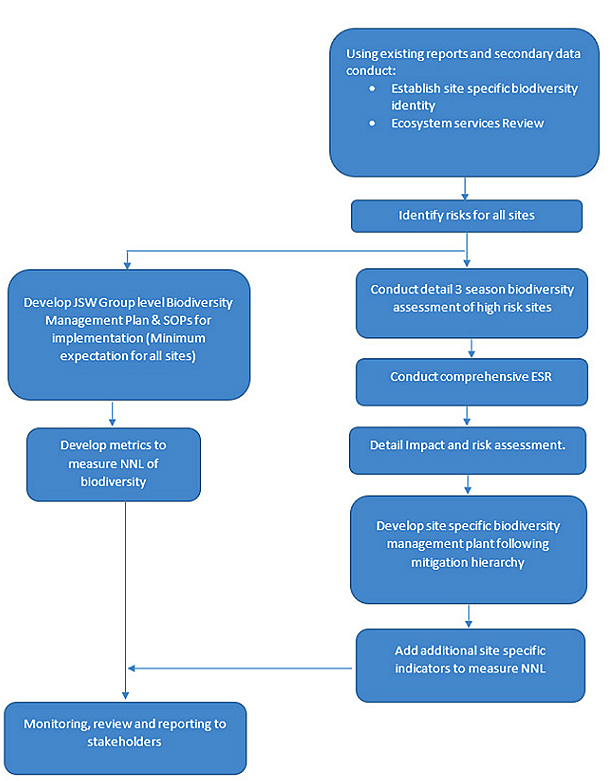
The risk assessment was conducted based the datasets provided by each site in the form of biodiversity Mapping (indicators developed by CII and shared with sites in excel format), documents provided such as EIA reports, site specific past biodiversity study reports, and secondary data sources. These documents were reviewed and assessed for developing impacts and dependencies matrix. Additionally, following aspects were taken into consideration while doing the risk assessment:
Additionally, Biodiversity risk management is integrated into multi-disciplinary company-wide risk management process.
Following key risks that have been identified:
To mitigate these risks and progress towards achieving our target of No Net Loss (NLL), we are adopting the following biodiversity risk mitigation hierarchy:
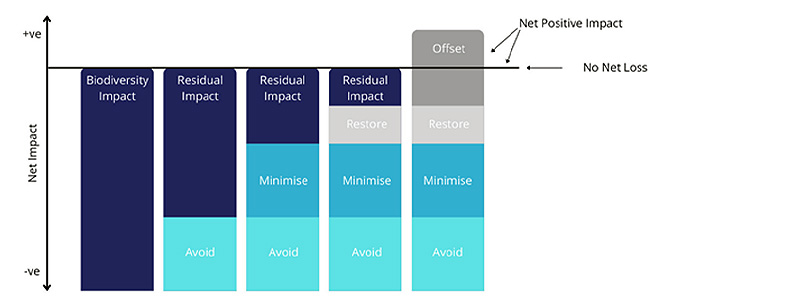
We shall consider ecological drivers, regulatory drivers, economic drivers and reputational drivers while applying above mitigation hierarchy to determine our action/intervention to manage biodiversity risks.
We have enlisted various activities/interventions along with their linkage with mitigation hierarchy which can be considered to reduce biodiversity risks during the different phases of the overall lifecycle of a manufacturing/mining location.
| Planning Phase | Construction Phase | Operation Phase |
|---|---|---|
| Avoidance of operations near protected areas, CRZ and Eco-sensitive zone of protected areas as per India’s protected areas, IUCN protected areas categories I-IV, UNESCO World Heritage Sites and wetlands | Avoidance through scheduling involves changing the timing of construction activities to avoid disturbing species during sensitive periods of their lifecycle. | Manual and machine removal of grasses and weed from the greenbelt areas. Removal of weeds and grasses after the flowering and seeding season is over (Monsoon and start of winter). Avoidance of weed and grass removal during nesting season of birds and wildlife (June to September). |
| Avoid acquiring Forest land and areas having high tree covers | Minimizing tree cutting during construction phase along with protecting native tress species in the acquired areas as per baseline assessment | Taking measures to reduce mortality to birds and bats by Windmill rotor blades |
| Minimization of land use change for the project through planning infrastructure | Avoidance or minimization of ground water extraction and surface water use during construction phase | Avoid sourcing of water from high conservation wetlands and rivers having high biodiversity areas |
| Integrating natural drainage system in the project design and avoidance of these areas during project planning phase. | Awareness creation of employees and workers for avoidance of snakes and birds nesting during management. | |
| Avoidance of migratory path areas of birds, wildlife and natural wetlands for land acquisition. | Avoidance or Minimization of extraction of ground water. |
Following are the actions that shall be implemented for restoration/rehabilitation of biodiversity or ecosystem services on which avoidance measures are not available and minimization measures are not possible.
| Construction Phase | Operation Phase | |
|---|---|---|
| Developing water harvesting structures to balance water requirement in construction phase | Developing landscape level interventions within project boundary to conserve water and regular maintenance of drainage system | |
| Plantation of native tree in high noise and dust areas as a barrier | Restoration of natural ecosystems within project boundaries | |
| Separately retaining and storing topsoil and sub-soil stripped from the construction areas for later use during reinstatement | Plantation of native trees species. Using indigenous and non-invasive species for landscaping and rehabilitation works. Using soil, mulch and vegetation debris (that contain natural seed stock) to facilitate natural revegetation of disturbed areas, where reasonably practicable. | |
| Developing Fireline to reduce fire incident during the dry sessions | ||
| Wetland convention - Principles and guidelines for wetland restoration to manage the Water requirements |
Following activities can be considered while offsetting the impact.
| Operation Phase |
|---|
| Undertake afforestation activity in the nearby areas of project to restore natural forest, control of invasive species and addressing drives of biodiversity loss. |
| Support local Forest office for protecting Rare, Endangered, Endemic and Threated Wildlife considering the criticality of the project and impacts on the specific species. |
| Wetland convention - Principles and guidelines for wetland restoration in proximity of the projects and sourcing location of water. |
| Invest in implementation of Ecosystem-based solution over technological solution for addressing biodiversity impacts (Ex. sewage water treatment for villages to reduce pollution load in natural wetlands and rivers) |
Understanding Biodiversity Exposure and Impacts
JSW Energy conducts location-specific Environmental Impact Assessments for 100% of its operational sites. The assessments cover the Company’s own operations and surrounding areas of influence and evaluate terrestrial and aquatic habitats, flora and fauna, protected and ecologically sensitive areas, migratory routes, breeding grounds, ecosystem services and potential operational impacts and dependencies.
The assessments use field surveys, ecological sampling, stakeholder consultation, literature review and primary and secondary environmental data. The assessments are aligned with national regulations, IFC Performance Standard 6, the Equator Principles and ADB safeguards. Identified impacts are addressed through the mitigation hierarchy of Avoid, Minimise, Restore and Offset and incorporated into site-specific Environmental and Social Management Plans and monitoring programmes. In addition, the Company has established a group-wide technical standard for Biodiversity Management Plans (BMPs), which is applied across ongoing and upcoming projects to ensure a consistent and systematic approach to biodiversity risk management and conservation.
For example, the Alampur Solar Power Project ESIA assessed biodiversity within the project site and a 10 km study area, including terrestrial and aquatic sampling locations. The assessment found no notified ecologically sensitive area within 10 km, no rare or threatened plant species and no Schedule I fauna. The project’s biodiversity risk was assessed as low, with measures covering native plantation, controlled vegetation clearance, wildlife-sensitive vehicle movement, site fencing, wildlife-sighting protocols and environmental monitoring.
| Biodiversity exposure and assessment | Number of sites | Area (Ha) | Coverage |
|---|---|---|---|
| Total operational sites | 22 | 10,140 | 100% |
| Sites covered by impact assessment | 22 | 10,140 | 100% |
| Sites with significant biodiversity impact | 1* | 239.50 | 100% |
| Exposed sites covered by Biodiversity Management Plans | 100% of exposed site | ||


