


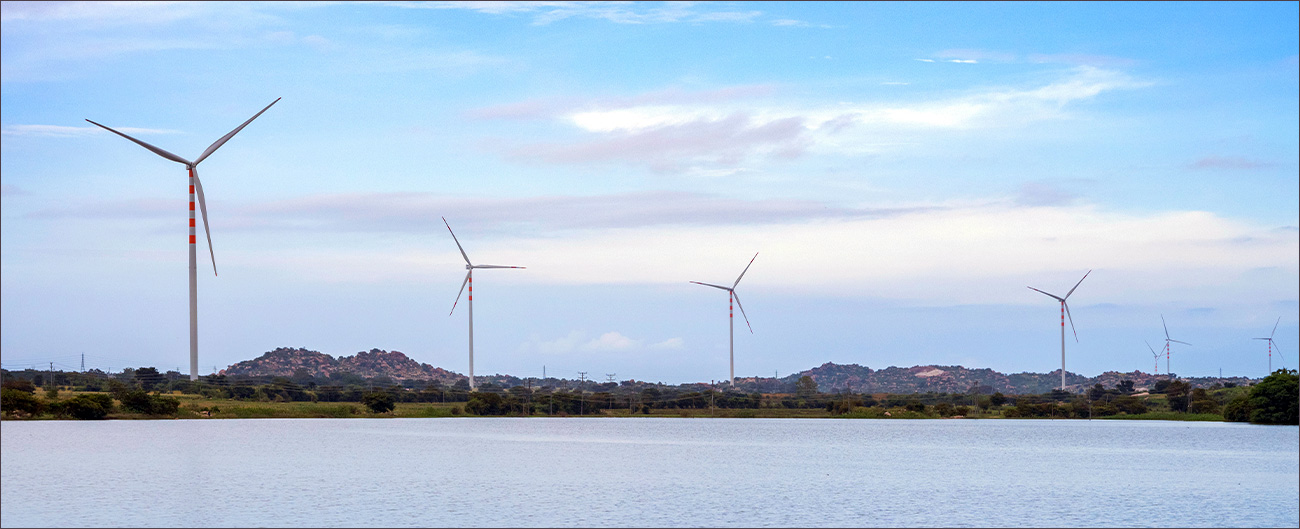
India’s transition towards renewable energy has accelerated due to policy stability, long-term investment frameworks, and global climate commitments. According to IEEFA, India’s renewable energy trajectory remains structurally strong despite short-term capacity challenges.
Government of India data confirms that India is moving steadily towards a more sustainable energy future by scaling clean energy capacity. The growth of renewable energy in India is directly linked to its ability to reduce fossil fuel dependency while increasing grid stability.
Government-backed policy frameworks, strong domestic manufacturing and long-term investment models drive India’s wind energy development. As per IRENA RE Statistics 2025, globally, India stands 4th in Wind Power capacity.
Ministry of New and Renewable Energy (MNRE) confirms that India has introduced strategic reforms enabling private investments and grid-linked wind power plants across multiple states. The role of the Indian Renewable Energy Development Agency has been central in financing and de-risking large-scale renewable energy projects.
India set a new national record in combined solar and wind power generation in the first half of 2025, driven by the rapid commissioning of new wind power plants.
MNRE confirms that India possesses strong domestic manufacturing capacity, producing approximately 18,000 MW per annum of wind equipment, strengthening the wind turbine ecosystem in India. Ember Energy highlights that India’s wind capacity expansion is now structurally aligned with global climate trajectories.
Wind energy is an emissions-free source of green energy that significantly reduces air and water pollution. Wind farms do not require water for cooling and help reduce total carbon emissions. Wind energy contributes to biodiversity preservation, land efficiency, and overall clean energy transition.
The combination of wind turbines and energy storage is transforming how renewable energy in India supports grid reliability.
JSW Energy has emerged as one of the most influential private players accelerating wind power in India through consistent, utility-scale investments and disciplined execution. Rather than treating wind as a peripheral asset class, the company has positioned it as a core pillar of its renewable energy transformation strategy.
In FY26, JSW Energy added 2,579 MW renewable capacity, taking the company’s renewable assets’ overall installed generation capacity to 7,796 MW MW. Net renewable energy generation during FY26 increased by 68% YoY driven by organic capacity additions and acquisition of O2 power.
This milestone reflects a wider strategic shift where wind is no longer a supplementary resource but a primary growth driver in the company’s long-term portfolio. As of Q4 FY26, JSW Energy operates approximately 3,656 MW of wind power capacity and has publicly committed to achieving 30 GW of total generation capacity by 2030, with wind forming a major share of this roadmap.
Beyond numbers, what distinguishes JSW Energy’s wind strategy is its execution in at scale-projects designed to be grid-stable, long-term assets backed by strong power purchase agreements, helping stabilise India’s transition towards clean energy reliability.
JSW Energy operates a geographically diversified portfolio of large-scale wind power plants that support both regional grids and national renewable energy targets. A significant portion of this portfolio is anchored in projects connected to the Solar Energy Corporation of India (SECI), which ensures long-term offtake stability and financial viability.
Key operational SECI wind projects include:
These projects are designed for long operational lifecycles and are backed by robust Power Purchase Agreements (PPAs), providing predictable cash flows and contributing meaningfully to the expansion of India's renewable energy infrastructure.
A major turning point in scaling capacity came through the Mytrah Energy acquisition, which added 1,331 MW of wind energy in India. This acquisition significantly strengthened the company’s geographic footprint and operational scale.
Today, JSW Energy manages wind power plants across multiple high-potential wind corridors, including:
This multi-state footprint not only improves generation resilience but also supports regional development and employment, strengthening the national wind power ecosystem in India.
Innovation sits at the core of JSW Energy’s wind growth strategy. Instead of relying solely on imported equipment, the company has moved toward building domestic industrial capability.
A major strategic step was entering into a licensed manufacturing partnership with SANY Renewable Energy to manufacture wind turbine generators and blades within the wind turbine supply chain in India. This move strengthens domestic manufacturing, reduces import dependence, and improves the long-term cost efficiency of wind turbine deployment.
Beyond generation, the company has set ambitious transformation goals:
These targets reflect a shift from conventional power thinking to a future-focused green energy model where generation, storage, and grid stability coexist within the same strategic framework.
In addition, JSW Energy has commissioned India’s largest green hydrogen plant, positioning itself at the convergence point of wind power, hydrogen, and next-generation clean energy technologies. This step signals a long-term ambition to lead not only in generation but in the future architecture of sustainable power in India.
India’s path towards a sustainable future is now structurally anchored in wind energy and broader renewable energy systems. The expansion of wind power plants, robust financing by the Indian Renewable Energy Development Agency, and domestically built wind turbines are creating a resilient clean energy ecosystem.
JSW Energy stands as one of India’s strongest private-sector contributors to this transformation, driving scale, infrastructure credibility and long-term value in wind power in India.
As the capacity of wind energy in India continues to expand, the sector will remain central to ensuring economic resilience, climate commitment and national energy independence.


