


India’s wind energy sector has evolved from experimental installations to sophisticated utility-scale wind turbine projects that deliver competitive electricity whilst contributing to national decarbonisation goals. At JSW Energy, our approach to wind power plant development combines rigorous site assessment, advanced engineering, and operational excellence, resulting in a portfolio of 4,122 MW (incl. hybrid) that demonstrates the technical and commercial viability of wind energy at scale.
India possesses substantial wind resources, with the National Institute of Wind Energy (NIWE) estimating potential exceeding 300 GW at 100-metre hub heights. This resource concentrates in coastal regions and elevated plateaus where consistent wind patterns enable high-capacity utilisation. However, harnessing this potential requires methodical site evaluation and engineering precision.
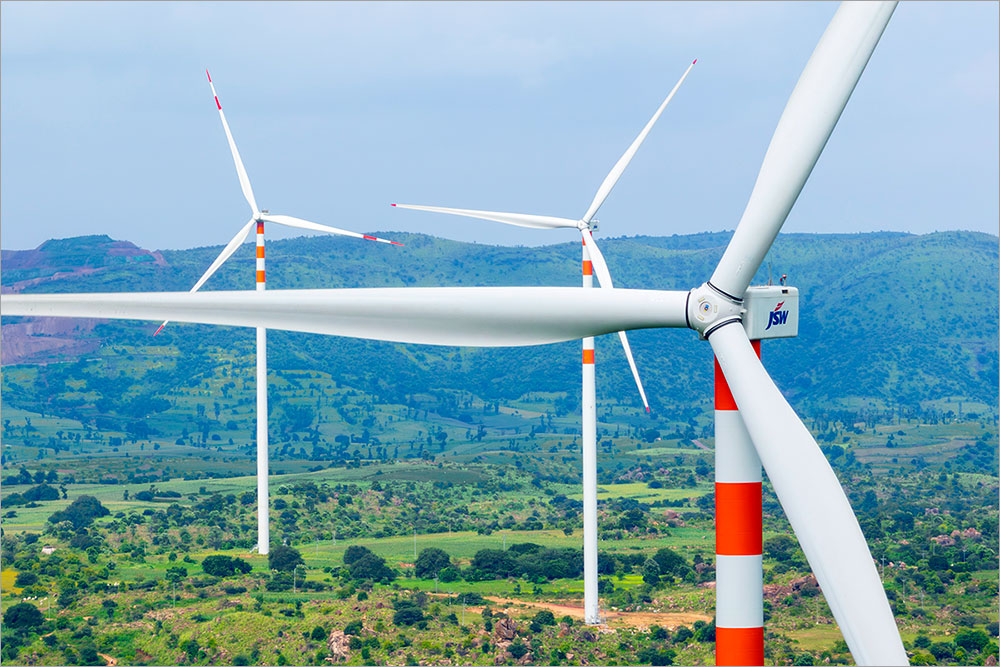
Our site selection process begins with comprehensive resource assessment using meteorological data, satellite imagery, and ground-based measurements. We deploy LiDAR (Light Detection and Ranging) systems to characterise wind profiles at proposed hub heights, capturing seasonal variations and diurnal patterns that inform yield projections.
This technical diligence proves essential for project viability. Wind speeds varying by just 0.5 meters per second can alter annual energy production by 15-20%, directly impacting project economics. We therefore invest substantial effort in understanding micro-climatic conditions before committing capital to development.
Effective wind farm siting balances multiple technical considerations: wind resource quality, grid connectivity, land availability, environmental sensitivities, and community acceptance. We employ geospatial analysis to identify locations that satisfy these criteria, prioritising sites with consistent wind patterns, proximity to transmission infrastructure, and minimal environmental constraints.
Terrain characteristics significantly influence turbine performance. Our wind turbine projects in Tamil Nadu's coastal plains benefit from strong sea breezes, whilst installations in Karnataka's elevated plateaus leverage orographic wind enhancement. Understanding these regional variations allows us to optimise turbine specifications for local conditions.
Our wind energy expertise encompasses the complete project lifecycle: resource assessment, engineering design, construction management, grid integration, and ongoing operations. This integrated capability enables us to execute projects efficiently whilst maintaining quality standards that ensure long-term performance.
Wind turbine installation demands precision engineering and coordinated logistics. Our teams employ specialised equipment-crawler cranes with 500-tonne capacities, custom transport systems for oversized components, and GPS-guided foundation construction-to install turbines safely and efficiently.
JSW Energy has developed standardised installation protocols that reduce construction duration whilst maintaining safety standards. These protocols proved instrumental in our rapid 1.3 GW wind capacity addition during FY2025, representing approximately one-third of India's total wind turbine installations for that year.
Our operational wind portfolio spans multiple states and encompasses various turbine technologies. This geographic and technological diversification optimises portfolio-level performance, ensuring consistent generation despite regional weather variations. The portfolio includes both ISTS (Inter-State Transmission System)-connected projects and state-connected facilities, providing flexibility in power evacuation and market access.
Technical performance metrics validate our engineering approach. Our wind turbine projects achieve capacity utilisation factors (CUFs) ranging from 28% to 35%, depending on site characteristics-figures that compare favourably with international benchmarks and exceed initial yield assessments in most cases.
Our participation in Solar Energy Corporation of India (SECI) wind auctions has yielded significant capacity additions. SECI IX and SECI X projects, totalling 1,264 MW, demonstrate our ability to develop large-scale wind farms that meet stringent technical specifications whilst delivering power at competitive tariffs.
These wind turbine projects employ 2.5-3.3 MW class turbines with rotor diameters exceeding 130 meters and hub heights of 120 meters. Such specifications optimise energy capture from available wind resources, particularly during monsoon seasons when wind speeds peak in project locations.
Grid integration for these projects required sophisticated engineering solutions. We implemented advanced power evacuation systems with 765 kV transmission links, reactive power compensation, and supervisory control systems that ensure grid stability despite variable wind generation.
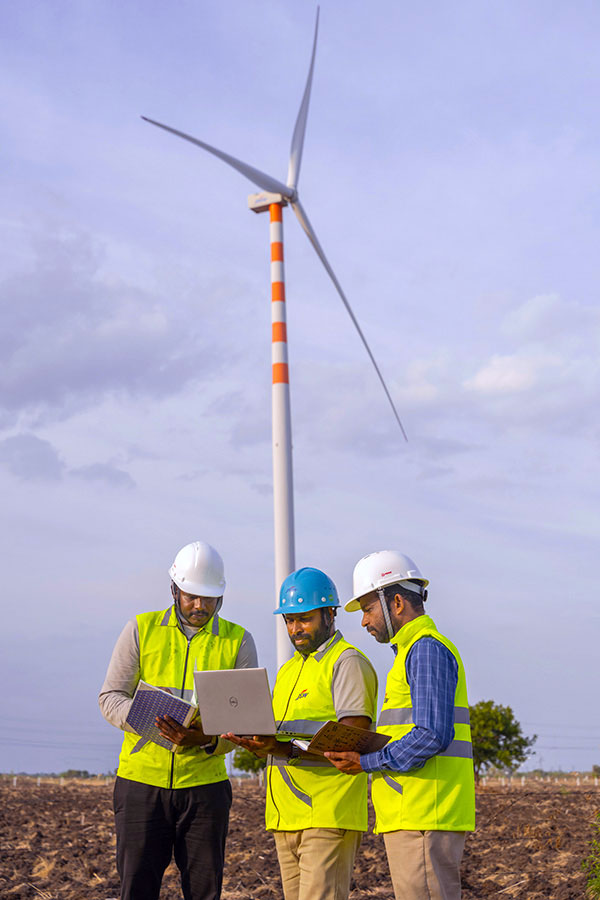
Our SECI projects consistently achieve CUFs exceeding 30%-a testament to accurate resource assessment and effective operations. We employ predictive maintenance strategies using vibration analysis, thermography, and performance monitoring systems that identify potential issues before they impact generation. This proactive approach maximises availability whilst controlling operations and maintenance expenditure.
Recognising the strategic importance of component security and quality control, we have established wind turbine blade manufacturing capabilities through a technology licensing agreement with SANY Renewable Energy. Our blade manufacturing facility in Halol, Gujarat has an annual capacity of up to 450 blades (equivalent to 600 MW of wind projects). The facility produces 82-meter blades for 4 MW wind turbines to vertically integrate operations, lower capital costs, and meet domestic content rules.
The SANY partnership provides access to proven blade designs and manufacturing processes. We have adapted these technologies for Indian conditions, incorporating reinforcements for cyclone resistance and surface treatments suited to tropical climates. This localisation ensures long-term blade performance in demanding operational environments.
Our manufacturing facility employs vacuum-assisted resin transfer moulding (VARTM) processes that produce consistent, high-quality blades. The facility's capacity aligns with our development pipeline, ensuring component availability whilst creating local employment and supporting India's renewable energy manufacturing ecosystem.
Effective wind power plants requires robust transmission infrastructure and sophisticated grid management. Our projects connect predominantly to ISTS, enabling power evacuation to multiple states and reducing exposure to regional demand variations.
ISTS connectivity provides access to India's national electricity market, allowing us to serve customers across state boundaries. However, this connectivity demands compliance with stringent technical standards for power quality, voltage regulation, and frequency control. We meet these requirements through advanced power electronics and real-time grid monitoring systems.
Our projects contribute to grid stability through ancillary services-providing reactive power support, voltage regulation, and ramp rate management that facilitate renewable energy integration at system level.
Wind energy technology continues advancing, offering opportunities for improved performance and reduced costs. We monitor developments in larger turbines, advanced materials, and digital twins that promise enhanced efficiency and reliability.
Emerging turbine designs with 5+ MW capacities and 160+ meter rotor diameters could increase energy capture by 20-30% compared with current wind turbine installations. We evaluate these technologies for future projects, balancing performance gains against infrastructure requirements and logistical constraints.
JSW Energy’s ambitious target of 30 GW generation capacity by FY2030 includes substantial wind capacity additions. Achieving this goal requires continued excellence in project development, strategic site acquisition, and technology partnerships. We approach this expansion systematically, applying proven methodologies whilst embracing innovation that enhances project economics and environmental performance.


