


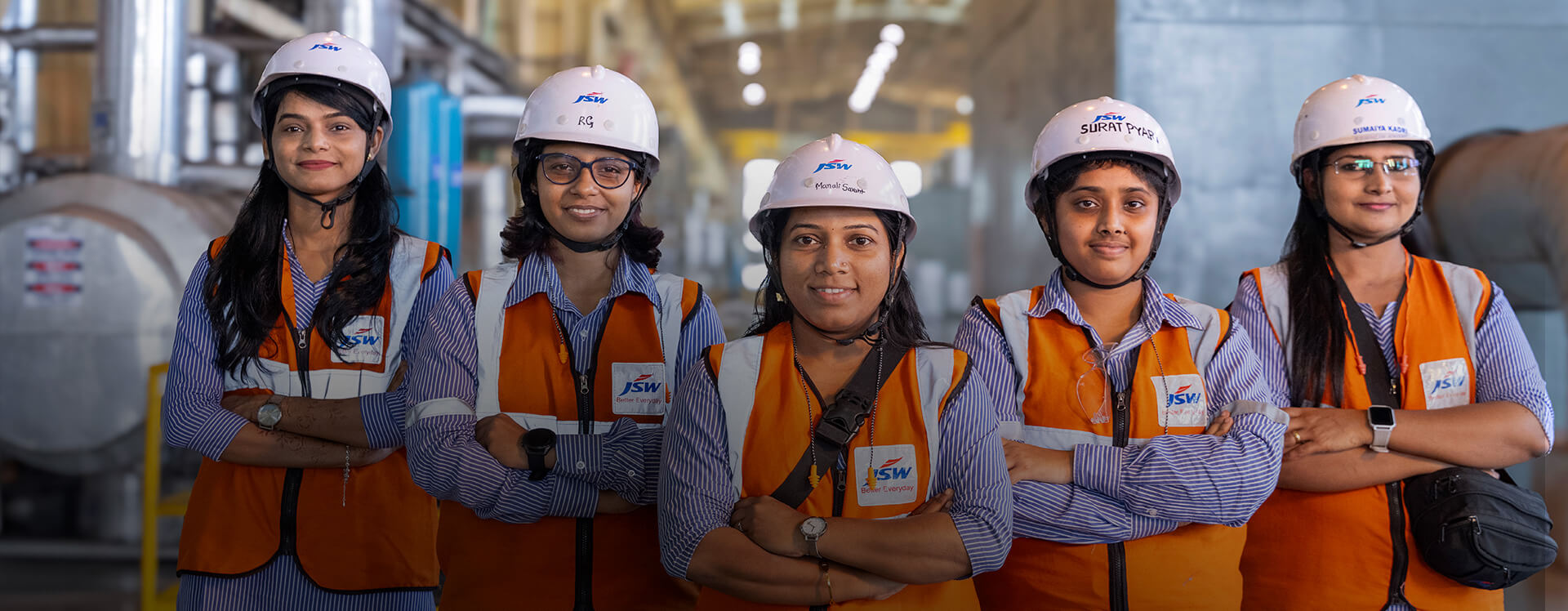
Human capital is the backbone of any industry. In an organization with the provision of good working conditions, employees are highly likely to be more positive, more motivated, and therefore more productive. Other benefits include higher employee retention rates, reduced instances of employee unrest, fewer grievance claims, etc. However, even today, many companies across the world fail to recognize even the most basic employment rights, and use labour practices, including child labour and forced labour, which would be considered abhorrent within any modern society. JSW has taken various efforts and initiatives to promote healthy and safe work environment for all its employees through focus on prevention of occupational accidents and diseases.
Occupational Health and Safety is a material topic for us at JSW, and the safety of its employees is fundamental to the reputation and performance of our Company. Highest priority is accorded to the principle of prevention.
Our approach to occupational health and safety is supported by the following key systems and practices:
Health and safety criteria form a part of our contracts with all suppliers. Before onboarding, a PQA (Prequalification Assessment) is conducted; only vendors scoring more than 50% are eligible to enter a contract with JSW Energy.
We have established an emergency response plan at the plant level as a Standard Operating Procedure (SOP) for situations such as fire, earthquakes, or floods. Mock drills are conducted for critical activities.
The Major Safety Systems being used at JSW Energy are as follows:
We hired 2511 employees in the reporting period. During this time, the total turnover rate stood at 7.66%, and 100% of the employee turnover was voluntary.
| Internal Hires | |||
|---|---|---|---|
| FY 2022-23 | FY 2023-24 | FY 2024-25 | FY 2025-26 |
| 145 | 215 | 234 | 260 |
Average Hiring Cost/FTE (INR)
| Average Hiring Cost/FTE (INR) | ||||
|---|---|---|---|---|
| FY 2021-22 | FY 2022-23 | FY 2023-24 | FY 2024-25 | FY 2025-26 |
| 1,11,772.57 | 93,078.10 | 39,514.31 | 72,722.27 | 68,513 |
Our employee engagement and benefits approach are supported by the following key programmes and initiatives:
| Employee Stock Ownership Plans | Flexible Work and Parental Benefits | Employee Satisfaction |
|---|---|---|
| We reward our employees through two ESOP schemes: JSWEL Employees Stock Ownership Plan – Samruddhi 2021 and JSWEL Employees Stock Ownership Plan – 2021. These cover 100% of our employees. Eligibility is tied to KRAs, which include sustainability components like safety performance and plant-specific parameters like energy and water consumption. | We provide flexible working hours (“flexi time”), requiring core attendance while allowing start times 1.5 hours before or after the standard time. We also introduced “short leave” allowing 4 hours of leave per month. Parental benefits include 26 weeks of maternity leave and one week of paternity leave, applicable to adoption, surrogacy, and fostering. If employees require additional paid leave for family or caregiving responsibilities beyond their parental leave entitlement, they have the flexibility to utilize their annual leave balance. The annual leaves also enable employees to support dependents including children, spouses, partners, parents, or others with physical or mental health conditions. Creche facilities and lactation rooms are available at all plant locations, while corporate employees receive financial assistance for childcare. | We conducted an employee satisfaction survey during the reporting period and the survey included assessing employees on various parameters – including job satisfaction, a sense of purpose, happiness at the workplace, and managing stress at the workplace, among others. |
Employee Satisfaction Score
| Employee Satisfaction Score | ||||
|---|---|---|---|---|
| FY 2021-22 | FY 2022-23 | FY 2023-24 | FY 2024-25 | FY 2025-26 |
| 74% | 74% | 86% | 82% | 81% |
Our performance management framework is structured around the following appraisal process and approach:
| Performance Appraisal Process | Performance Appraisal Approach |
|---|---|
| Our performance management uses a comprehensive appraisal process based on Key Result Areas (KRA). This includes Performance Planning at the start of the year, Mid-year Reviews, and a Year-end Assessment followed by a Calibration process. Agile conversations between managers and employees occur throughout the year. | The process integrates four key approaches:
|
We utilize a multi-dimensional appraisal system for selected levels and a recognition portal named “Spotlight”. Safety standards are linked to team goals; if zero-fatality targets are not met at a site, all employees at that site are assessed as a team, impacting variable pay.
We provided an average of 22.9 hours of training per employee and spent INR 19,887 per employee on training and development for FY 2025-26.
Training and Development Metrics
| Training and Development Metrics | ||||
|---|---|---|---|---|
| FY 2022-23 | FY 2023-24 | FY 2024-25 | FY 2025-26 | |
| Average hours of training per employee | 17.07 | 25.52 | 29 | 22.9 |
| Average amount spent per employee on training and development | 4434 | 5352.36 | 14,381 | 19,887 |
| Average Training Hours (FY 2025-26) | ||
|---|---|---|
| Male | Female | |
| Senior Management | 1.41 | 4.50 |
| Middle Management | 21.48 | 11.60 |
| Junior Management | 23.56 | 24.27 |
| Non-Management Level | 8.71 | 41.23 |
Our coaching and employee networks support leadership development, learning and collaboration through the following initiatives:
| Executive and Managerial Coaching | Diversity and Inclusion Networks | Structured Coaching Programme |
|---|---|---|
| Coaching interventions at JSW Energy empower leaders and build a future-ready workforce. This includes executive coaching with certified external coaches for senior leaders and managerial coaching for mid-level leaders. | We also foster community through the Diversity and Inclusion (D&I) Council and the Women Network. | A structured coaching program comprising 12-14 sessions is designed and implemented based on specific requirements. Progress is reviewed through quarterly or mid-program reviews, and all sessions are facilitated by industry-recognized coaches. |
Our training and development programmes focus on strengthening employee capabilities, supporting career growth and building readiness for future roles.
This leadership program is designed in collaboration with Brown University, USA. It’s a 6-8 months of development journey which includes online coaching and mentoring, 6 days of residential program and one OJT assignment. This program has enabled the participants to have bird-eye view of their respective domains and understand the industry best approach in terms of program execution and development. The programme covered 2 employees during FY 2025-26. Successful completion of this program makes the senior person eligible for leadership level role across JSW Group.
Identifies high-potential talent; assessed 478 employees in middle, junior management and Senior management. The 6–9 month experiential journeys for Bands 3 -5 are designed to build self-awareness, leadership capability and an enterprise perspective among emerging leaders. The journey brings together leadership labs, individual development planning with managers and coaches, academic immersion, executive presence workshops, fireside conversations with senior leaders and industry immersion to provide participants with a holistic leadership experience. The program culminates in a graduation ceremony, enabling participants to reflect on their learnings, translate them into action and take the next step in their leadership journey.
Personal Financial Awareness sessions were conducted through engaging webinars led by external financial experts. The sessions focused on building awareness around the fundamentals of investing, financial planning, and making informed decisions to help employees understand how to manage and grow their money. 1000+ employees were covered under this programme.
“Pillars of Success Post Retirement” provided practical strategies for 100 participants.
• Includes "Digivolve" for Industry 5.0 skills and Digital Induction for new joiners.
• Six instructor-led sessions of approximately 2.5 hours each were conducted to enhance employees’ digital technology skills and build awareness of the various modules and functionalities available on SAP. The sessions provided employees with practical understanding of how to leverage SAP effectively in their day-to-day work. 2000+ employees were covered inder these sessions.
• JSW Energy’s Digital Induction Model, supported by leadership video messages and hybrid onboarding tools, ensures a seamless and engaging experience for new joiners. We have launched a 2-days of online leadership orientation program for all the new joiners which happens every month starting Sep ’25. 1109 employees were covered under this. In parallel, the MyLearning Academy platform fosters a self-paced, gamified learning environment, enabling continuous capability development across locations. It led to an increase in efficiency with a 70% reduction in turnaround time (TAT) by streamlining access to key systems and processes, helping new employees contribute efficiently to business objectives.
JSW Energy strengthened its focus on workforce safety by imparting Global Wind Organisation (GWO)-certified training to 24 employees engaged in high-risk wind operations. The programme also extended to contractual workers, with 160 contractual workers receiving GWO certification.
During FY 2025-26, interactive sessions on “Breaking Bias” were conducted to raise awareness of unconscious biases, challenge preconceived notions, and encourage inclusive decision-making and workplace interactions. The programme covered 146 managers, representing an approximately 70% year-on-year increase in participation.
| Future Fit Leaders |
|---|
| The Future Fit Leaders programme, created by ISB Executive Education in collaboration with the JSW Group, brought together employees from across the group’s businesses for a structured leadership programme at the ISB campus. But for many participants, some of the most valuable learning happened outside formal classroom sessions, through conversations with colleagues navigating similar challenges in very different parts of the organisation. Several participants spoke about the importance of stepping away from day-to-day operational demands and engaging with peers from across the group. In many cases, discussions revealed how different businesses were grappling with similar leadership and market challenges, often in isolation. The programme created space for participants to exchange ideas, compare approaches, and reflect on how similar problems were being solved across the organisation. We have 15 employees from Energy who have underwent FFL at the Group level. |
Our well-being and equal opportunity initiatives are not only extended to our employees but also to our contractual workforce. As part of our human rights commitment, we impart trainings to our contractual workers on equal opportunity, physical as well as mental wellbeing. The trainings also help us in understanding the diverse cultural background of their co-workers and adapt to the workplace environment.


